Are Takis Bad for You? Ingredients, Salt and Your Stomach
Are Takis bad for you? Takis ingredients, salt and dyes explained, what spicy chips do to your stomach, and how Blue Heat, Doritos and others compare.
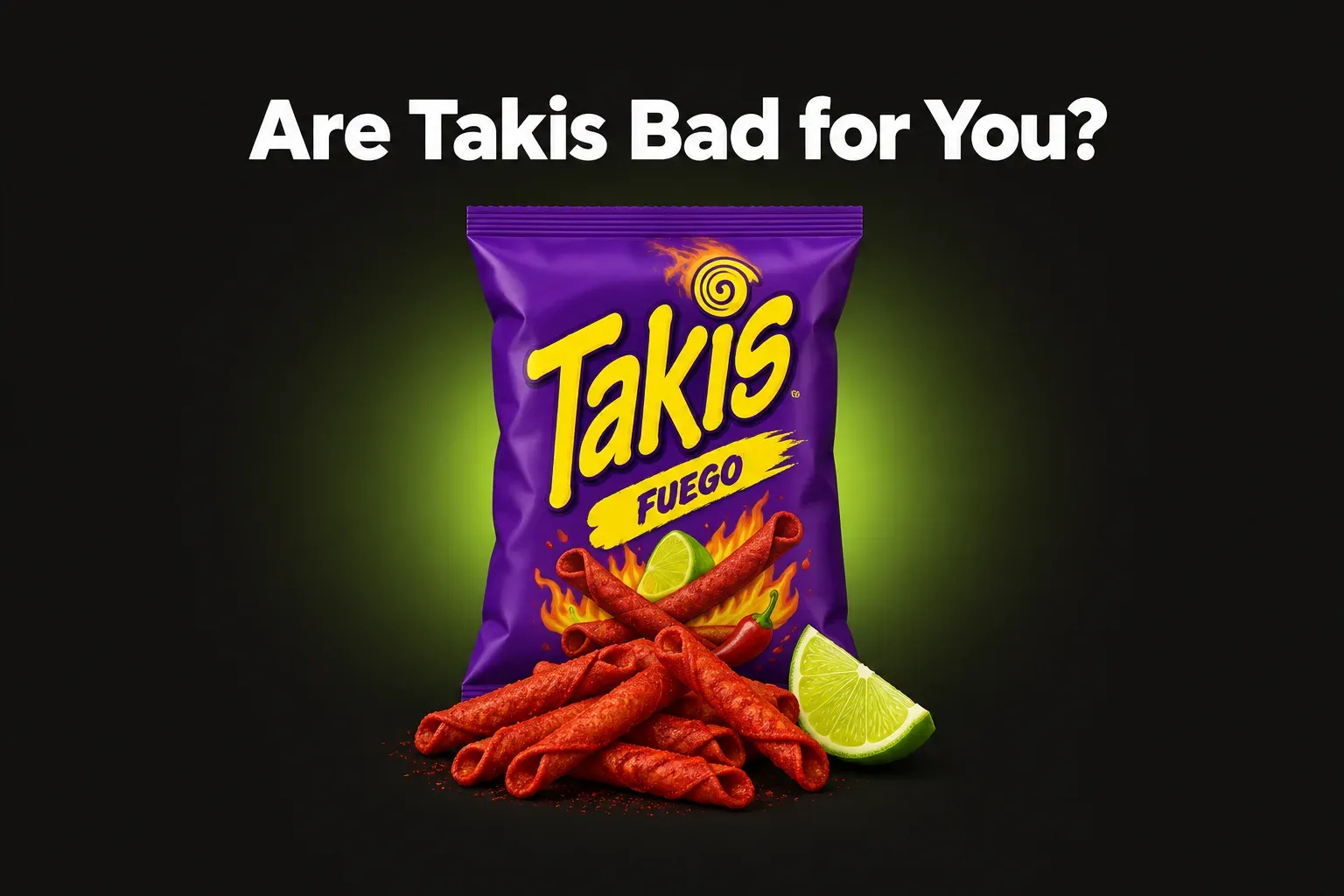
Takis are the rolled, extra-spicy tortilla chips in the purple bag that kids and teens love. But are Takis bad for you?
The short answer: a small handful now and then is fine for most healthy people. But Takis are ultra-processed, and Takis Fuego are saltier than most spicy chips. One ounce has 420 mg of sodium. The classic label also lists lab-made dyes (Red 40 and Yellow 6) and the preservative TBHQ. The chili heat won’t burn a hole in a healthy stomach. But eating a whole bag can upset your stomach and give you more than a full day’s salt.
Takis ingredients: what’s in a bag of Takis Fuego
Here is the label for 1 oz (28 g) of Takis Fuego Hot Chili Pepper & Lime. That’s about 12 chips.
| Per 1 oz (28 g) | Amount |
|---|---|
| Calories | 150 |
| Fat | 8 g |
| Saturated fat | 2.5 g |
| Sodium | 420 mg (18% of the Daily Value) |
| Carbohydrates | 17 g |
| Fiber | 1 g |
| Sugar | 1 g (0 g added) |
| Protein | 2 g |
Source: Takis Fuego label on SmartLabel. Open Food Facts shows the same numbers, with 16 g of carbohydrates.
Here are the Takis Fuego ingredients, in label order:
- Corn flour (processed with lime) – masa flour, the same kind used for corn tortillas. Here, “lime” means a mineral (calcium hydroxide), not the fruit.
- Vegetable oil (palm and/or soybean and/or canola oil) – the oil the chips are fried in. It gives most of the fat.
- Seasoning – the red, spicy powder on the outside. The label lists what’s in it:
- Salt – the first seasoning on the list, and the main source of the sodium.
- Maltodextrin – a starch powder. It carries the seasoning and helps it spread.
- Citric acid – a sour acid also found in lemons. The label lists no lime juice. So citric acid and the flavors give the “lime” taste.
- Sugar – only a tiny amount. The label rounds added sugar to 0 g per ounce.
- Monosodium glutamate (MSG) – a flavor booster with a savory, meaty taste.
- Hydrolyzed soy protein – soy protein broken into small bits. It adds more savory taste.
- Onion powder – dried, ground onion.
- Yeast extract – a savory flavor made from yeast.
- Red 40 Lake and Yellow 6 Lake – lab-made dyes that make the chips bright red.
- Natural and artificial flavors – flavor mixes the label doesn’t spell out.
- Sodium bicarbonate – plain baking soda.
- Soybean oil – a little more oil, inside the seasoning.
- Chili pepper – ground chili, for heat.
- Disodium inosinate and disodium guanylate – two more flavor boosters that work with MSG.
- TBHQ – a lab-made preservative. It keeps the oil from going stale.
Source: Takis Fuego ingredients on SmartLabel, the brand’s label page. Open Food Facts shows the same list for a US bag.
New bags say “No Artificial Colors Added” on the front. The maker says they have no Red 40, Yellow 6 or TBHQ. We couldn’t find the full new label yet, so check the back of your bag.
A few things stand out:
- Three flavor boosters – MSG, disodium inosinate and disodium guanylate – make the chips taste stronger. Together with salt and fat, they make it hard to stop eating.
- Chili pepper comes near the end of the list. So there’s less of it than most of the other seasonings.
Most people don’t stop at 1 oz. A 9.9 oz (280 g) bag has about 10 servings. That’s about 1,500 calories, 80 g of fat and 4,200 mg of sodium in one bag.
Salt: the biggest problem
The FDA says adults should eat less than 2,300 mg of sodium a day. For children, the limits are even lower. The FDA also says that 20% of the Daily Value or more in one serving is “high” (FDA). One ounce of Takis Fuego has 18%, so it’s close.
That’s for just 12 chips. Three ounces – about 36 chips – give you over half a day’s sodium. A big bag gives you almost two days’ worth.
Too much salt raises blood pressure, even in kids. A CDC study looked at more than 6,000 US children aged 8 to 18. On average, they ate 3,387 mg of sodium a day – far over the limit. Kids who ate more salt had higher blood pressure. Among overweight kids, the saltiest eaters were about 3.5 times more likely to have high or near-high blood pressure (Yang et al., Pediatrics, 2012).
Can Takis hurt your stomach?
You may have seen news stories about kids in the ER after eating spicy chips. In 2013, a Los Angeles pediatrician said she saw five to six children a day with gastritis. Gastritis is a swollen, irritated stomach lining. She linked it to bags of spicy snacks (UPI, 2013). Those reports were about spicy snacks in general, not only Takis. They were doctors’ stories, not a study.
What does research say about chili heat itself?
- Spicy meals and the stomach. 12 healthy adults ate four kinds of meals. One was a Mexican meal with about 30 g of jalapeños. Doctors then looked inside their stomachs with a camera. The spicy meals caused no real damage. Only one person had one tiny sore. A bland meal with aspirin damaged the stomach in 11 of 12 people (Graham et al., JAMA, 1988).
- Chili and ulcers. A review found that capsaicin – the hot part of chili – does not cause ulcers. It may even help protect the stomach lining. The main causes of ulcers are a germ called H. pylori and painkillers like aspirin (Satyanarayana, Critical Reviews in Food Science and Nutrition, 2006).
- Sensitive stomachs. 54 people with ongoing indigestion and 61 healthy people swallowed a capsule with 0.75 mg of capsaicin. The people with indigestion got more stomach symptoms than the healthy people. About half of them were extra sensitive to it (Hammer et al., Neurogastroenterology and Motility, 2008).
So chili heat doesn’t harm a healthy stomach. But Takis are spicy, acidic and salty at the same time. And people often eat a whole bag on an empty stomach. That can bring on stomach pain, heartburn, nausea or diarrhea. If you have reflux, gastritis or an ulcer, spicy chips can make it worse. Stomach pain that keeps coming back is a reason to see a doctor.
Red 40, Yellow 6 and Blue 1
The bright color of Takis comes from lab-made dyes. On the classic US labels:
- Takis Fuego: Red 40 Lake and Yellow 6 Lake
- Takis Blue Heat: Blue 1 Lake
- Takis Nitro: Red 40 Lake, Yellow 6 Lake, Yellow 5 and Blue 1 Lake
A “lake” is a dye bound to a mineral salt (aluminum), so the color doesn’t run. It’s still the same dye. Here’s what studies show:
- Behavior in children. In a large UK study, about 300 children drank fruit drinks with a mix of dyes and a preservative. On other days, they drank the same drink without them. No one knew which was which. On the dye days, the children were often more hyperactive (McCann et al., The Lancet, 2007). The effect was small, but it showed up in 3-year-olds and in 8- to 9-year-olds. Both dye mixes had Yellow 6. One also had Red 40. These were ordinary children, not only kids with ADHD.
- Gut health in mice. Mice ate Red 40 (Allura Red) every day for weeks. The dose matched what’s found in common foods. They became more likely to get colitis – painful swelling of the colon. Mice that got it early in life were also more at risk. Mice that ate it only now and then were not affected (Kwon et al., Nature Communications, 2022).
Why do mouse studies matter? Mice share most of our genes and body processes. And testing a possible gut disease on children would put their health at risk. We don’t yet know if Red 40 does the same in people. Still, it’s a warning sign. Together with the behavior study, it’s a good reason to limit dyes as a precaution.
Regulators are moving too. In April 2025, the FDA asked food companies to drop petroleum-based dyes by the end of 2026. These include Red 40, Yellow 5, Yellow 6 and Blue 1 (FDA, 2025). It’s a request, not a ban. In June 2026, Barcel USA, the maker of Takis, said it will remove artificial colors and TBHQ from its chips by the end of 2026. That includes its top sellers, Fuego and Blue Heat. New bags were already reaching stores like Walmart (Food Dive, 2026). But many stores still sell the old bags, so check the ingredient list.
TBHQ and MSG
TBHQ is a lab-made preservative made from petroleum. It keeps the oil in the chips from going stale. The FDA allows it in small amounts. But a team at Michigan State University has studied it for years:
- Immune cells. In lab dishes, TBHQ weakened natural killer cells from mice. These cells fight viruses and cancer cells (Boss et al., Food and Chemical Toxicology, 2018).
- Food allergies. Mice ate food with TBHQ and were then given an egg protein. They made more allergy antibodies and had worse allergic reactions than mice without TBHQ (Jin et al., Frontiers in Immunology, 2025).
There’s no proof yet that TBHQ in food harms people. But the signals are a good reason to limit it.
MSG (monosodium glutamate) has a worse reputation than it deserves. In a careful study, 130 people who said they react to MSG got 5 g of MSG or a placebo (a fake dose). That’s far more than a bag of chips has, and they took it without food. Some felt mild symptoms. But the reactions usually didn’t come back when they were tested again, and none were serious (Geha et al., Journal of Allergy and Clinical Immunology, 2000). The bigger issue is that MSG makes salty snacks taste extra good, so you eat more.
Palm oil and ultra-processing
Takis are made with an oil blend that can include palm oil. Palm oil is high in saturated fat. One ounce of Takis has 2.5 g of saturated fat. That’s more than Doritos or Cheetos (1–1.5 g).
Takis are also an ultra-processed food. They’re made from refined corn flour, oil, salt and many additives. In one NIH study, 20 adults lived in a clinic for four weeks. For two weeks, they ate ultra-processed meals. For two weeks, they ate unprocessed meals. On the ultra-processed diet, they ate about 500 more calories a day and gained about 2 lb (0.9 kg) (Hall et al., Cell Metabolism, 2019).
Takis flavors vs other spicy chips
| Chip (1 oz / 28 g) | Calories | Fat | Saturated fat | Sodium | Lab‑made dyes on label |
|---|---|---|---|---|---|
| Takis Fuego | 150 | 8 g | 2.5 g | 420 mg | Red 40, Yellow 6 |
| Takis Blue Heat | 150 | 8 g | 2.5 g | 180 mg | Blue 1 |
| Takis Nitro | 150 | 8 g | 2.5 g | 270 mg | Red 40, Yellow 6, Yellow 5, Blue 1 |
| Takis Zombie | 150 | 8 g | 2 g | 290 mg | Yellow 5, Blue 1, Yellow 6 |
| Doritos Flamin’ Hot Nacho | 150 | 8 g | 1 g | 190 mg | Red 40, Yellow 6, Yellow 5 |
| Cheetos Crunchy Flamin’ Hot | 160–170 | 11 g | 1.5 g | 210–250 mg | Red 40, Yellow 6, Yellow 5 |
| Paqui Haunted Ghost Pepper | 140 | 7 g | 1 g | 190–210 mg | None |
| Siete Fuego Tortilla Chips | 130 | 7 g | not listed | 125 mg | None (beet powder) |
| Late July Mild Green Mojo | 120 | 6 g | 0.5 g | 210 mg | None |
Takis Fuego, Blue Heat and Nitro: SmartLabel (Fuego, Blue Heat, Nitro). Zombie, plus 2026 checks of the other Takis: Open Food Facts (Zombie, Blue Heat, Nitro). Others: Open Food Facts (Doritos, Cheetos (1, 2), Paqui (1, 2), Siete, Late July). Ranges mean two US labels show different numbers. Dyes are from the classic labels; new Takis bags are dropping them.
What stands out:
- All Takis flavors have the same calories and fat. The big difference is salt.
- Takis Fuego has the most sodium – more than twice as much as Doritos Flamin’ Hot.
- Blue Heat lists potassium chloride, a salt swap, before regular salt. That helps explain its lower sodium.
- Siete, Paqui and Late July use no lab-made dyes and no TBHQ. Paqui and Late July also have much less saturated fat.
For more swaps, see our guides to the healthiest chips and the healthiest tortilla chips. Want a low-fat crunch? Read are pretzels healthy? – but they’re salty too.
How to enjoy Takis more safely
- Buy the small 1 oz bag. Don’t eat from the big bag.
- Pour a portion into a bowl – about 12 chips – and put the bag away.
- Don’t eat them on an empty stomach. Pair them with a meal, fruit or a glass of milk.
- Drink water, not soda, to balance the salt.
- Skip them if spicy food upsets your stomach or if you have reflux or an ulcer.
- Keep them a treat for kids, not a daily lunchbox snack.
See what’s really in your bag of Takis. With NutriSmart, you photograph the label or scan the barcode. The app lists the sweeteners, preservatives and colors, explains the risks of each one and gives the product a health score out of 100. It also tells you right away if a snack is ultra-processed and which ingredients make it so. Set an alert for Red 40 or TBHQ. The app then warns you whenever a product you scan contains it.Get the app free
The bottom line
Takis aren’t poison, and a small handful now and then won’t hurt most people. But they’re an ultra-processed snack with lots of salt and fat and little else. Takis Fuego have 420 mg of sodium per ounce, and a big bag has almost two days’ worth. The chili heat doesn’t damage a healthy stomach, but a whole bag can still cause pain and heartburn. The classic label also has Red 40, Yellow 6 and TBHQ, which several labs link to problems. Takis is removing them, so check your bag. Keep Takis a treat, stick to one small portion, and pick a less salty chip for every day.
FAQ
Are Takis bad for you?
A small handful now and then is fine for most healthy people. But Takis Fuego are very salty, with 420 mg of sodium per 1 oz. They also have lab-made dyes and the preservative TBHQ on the classic label. Eating a whole bag often is the real problem.
What are the ingredients in Takis?
Takis Fuego are made of corn flour, vegetable oil (palm, soybean or canola) and a spicy seasoning. The seasoning has salt, maltodextrin, citric acid, sugar, MSG, soy protein, onion, yeast extract, flavors and chili pepper. The classic bag also has Red 40, Yellow 6 and the preservative TBHQ, which new bags are dropping.
How many calories are in Takis?
A 1 oz serving of Takis Fuego (about 12 chips) has 150 calories and 8 g of fat. A 9.9 oz bag has about 10 servings. That's about 1,500 calories and 4,200 mg of sodium in one bag.
Can Takis hurt your stomach?
Chili heat alone doesn't damage a healthy stomach, studies show. But a big bag of spicy, acidic chips can cause stomach pain, heartburn or nausea. People with reflux or a sensitive stomach often feel it more.
Do Takis have Red 40?
The classic Takis Fuego label lists Red 40 Lake and Yellow 6 Lake. Blue Heat lists Blue 1 Lake. In June 2026, the maker said it will remove artificial colors and TBHQ by the end of 2026. Old and new bags are both in stores, so check the ingredient list.
Are Takis bad for kids?
They are fine as a rare treat, but not as a daily snack. A big 9.9 oz bag has almost twice an adult's daily sodium limit, and kids' limits are even lower. Artificial dyes have also been linked to more hyperactive behavior in children.
Which Takis flavor is the healthiest?
They all have about 150 calories and 8 g of fat per ounce. Blue Heat has the least sodium (180 mg), and Fuego has the most (420 mg). No flavor is a healthy snack, so the portion matters more than the flavor.