Doritos Ingredients: What's in Nacho Cheese Doritos
Doritos ingredients explained one by one: MSG, maltodextrin, Red 40 and Yellow 5, nutrition per ounce, the dye-free Simply NKD bag and simpler chips.
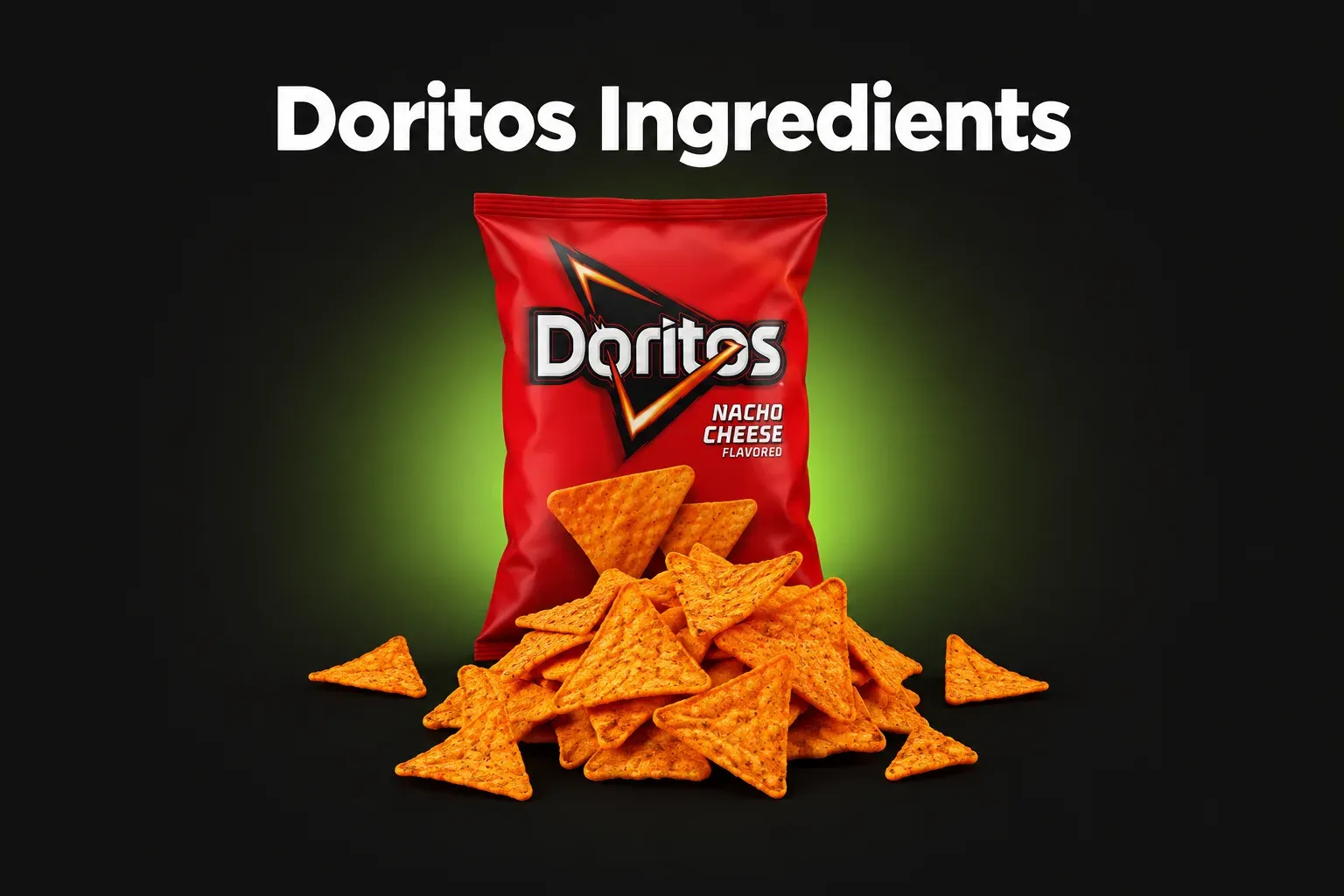
Doritos are the bright orange triangle chips in the red bag. But what’s actually in a Nacho Cheese Dorito?
The short answer: Nacho Cheese Doritos are mostly corn, vegetable oil and corn maltodextrin (a starch powder). Everything else is seasoning, and each seasoning ingredient makes up less than 2% of the chip. The seasoning has cheddar and romano cheese, salt, whey, buttermilk and MSG. It also has three lab-made dyes (Yellow 6, Yellow 5 and Red 40) and two more flavor boosters. A 1 oz serving has 150 calories, 8 g of fat and 170 mg of sodium. A small bag now and then is fine. But Doritos are ultra-processed and easy to overeat. The newer Simply NKD bag has no dyes and no MSG.
Doritos Nacho Cheese ingredients, one by one
Here is the ingredient list on a current US bag of Doritos Nacho Cheese, in label order. The label says each ingredient after maltodextrin makes up “less than 2%.”
- Corn – the base of the chip. The corn is made into a dough, cut into triangles and fried.
- Vegetable oil (corn, canola, soybean and/or sunflower) – the frying oil. “And/or” means the mix can change. It gives most of the fat.
- Corn maltodextrin – a starch powder made from corn. It’s a filler that carries the seasoning.
- Cheddar cheese – real cheese, dried into a powder.
- Salt – the main source of sodium.
- Whey – the watery part of milk left over from making cheese.
- Monosodium glutamate (MSG) – a flavor booster with a savory, meaty taste.
- Buttermilk – dried, slightly sour milk. It adds tang.
- Romano cheese – a sharp, salty hard cheese in powder form.
- Whey protein concentrate – whey with more of its protein kept in.
- Onion powder – dried, ground onion.
- Potassium salt – a salt made with potassium instead of sodium. It tastes salty with less sodium.
- Corn flour – finely ground corn.
- Natural and artificial flavors – flavor mixes the label doesn’t spell out.
- Dextrose – a simple sugar made from corn.
- Tomato powder – dried tomato, for a tangy taste.
- Lactose – milk sugar.
- Spices – the label doesn’t say which ones.
- Artificial color (Yellow 6, Yellow 5, Red 40) – three lab-made dyes. They make the chips bright orange.
- Lactic acid – a mild acid, the same one found in yogurt.
- Citric acid – a sour acid also found in lemons.
- Sugar – a tiny amount. Total sugars are under 1 g per serving.
- Garlic powder – dried, ground garlic.
- Skim milk – dried milk with the fat removed.
- Red and green bell peppers – dried and ground.
- Disodium inosinate and disodium guanylate – two flavor boosters that make MSG taste much stronger.
Source: US label of the Doritos Nacho Cheese 1 oz bag, photo from June 2026 on Open Food Facts.
The bag also says “Contains milk ingredients.” So people with a milk allergy should avoid Doritos Nacho Cheese.
What stands out: a Dorito is mostly corn, oil and starch. The cheese, spices and peppers are tiny amounts. Much of the “nacho cheese” taste comes from salt, MSG, flavor boosters, acids and added flavors.
Doritos nutrition facts per 1 oz
A serving is 1 oz (28 g), or about 11 chips:
| Per 1 oz (28 g), about 11 chips | Amount |
|---|---|
| Calories | 150 |
| Total fat | 8 g (10% of the Daily Value) |
| Saturated fat | 1 g |
| Trans fat | 0 g |
| Sodium | 170 mg (7% of the Daily Value) |
| Carbohydrates | 17 g |
| Fiber | 1 g |
| Sugars | less than 1 g |
| Protein | 2 g |
| Calcium | 50 mg |
| Potassium | 100 mg |
Source: US label of Doritos Nacho Cheese on Open Food Facts (photo from November 2026). The 9.25 oz bag shows the same numbers per serving.
The trouble is that few people stop at 11 chips. A 9.25 oz (262 g) bag has about 9 servings. If you finish it, you get:
- about 1,350 calories – more than half of what many adults need in a day;
- about 72 g of fat;
- about 1,530 mg of sodium – two-thirds of the 2,300 mg daily limit for adults (FDA).
Yet you get only about 9 g of fiber and 18 g of protein. That’s why chips don’t keep you full for long.
The dyes: Yellow 6, Yellow 5 and Red 40
The orange color comes from three lab-made dyes made from petroleum. The label doesn’t say how much of each is in the bag. The FDA allows all three. But studies raise questions, especially for children.
- Behavior in children. In a UK study, about 300 children drank fruit drinks with a mix of dyes and a preservative. On other days, they got the same drink without them. No one knew which was which. On the dye days, the children were a bit more hyperactive on average (McCann et al., The Lancet, 2007). The effect was small. The mixes included Yellow 6, Yellow 5 and Red 40, plus other dyes.
- A big review. California scientists looked at 25 studies that gave dyes to children. In 16 of them, dyes were linked to some behavior or attention problems. Animal studies pointed the same way. The authors said the FDA’s limits rest on old studies and may not protect sensitive children (Miller et al., Environmental Health, 2022).
- Gut health in mice. Mice ate Red 40 every day for weeks, at a dose found in common foods. They became more likely to get colitis – painful swelling of the colon. Mice that got it only now and then were not affected (Kwon et al., Nature Communications, 2022).
Why do mouse studies matter? Mice share most of our genes and body processes. And testing a possible gut disease on people would put their health at risk. Proof in humans is still missing for the gut effect. But several labs see warning signs. So it makes sense to limit these dyes as a precaution, especially for kids.
In April 2025, the FDA said it would work with food companies to remove petroleum-based dyes by the end of 2026. The list includes Red 40, Yellow 5 and Yellow 6 (FDA, 2025). It’s a request, not a ban. Classic Nacho Cheese labels photographed in 2026 still list all three.
MSG and the other flavor boosters
MSG has a worse reputation than it deserves. In one careful study, 130 people who said they react to MSG got 5 g of MSG or a fake dose, without food. That’s far more than a bag of chips has. Some felt mild symptoms. But the reactions didn’t come back reliably on retesting, and none were serious (Geha et al., Journal of Allergy and Clinical Immunology, 2000).
Disodium inosinate and guanylate boost the taste of MSG. The body turns them into uric acid. Too much uric acid can trigger gout attacks. So people with gout may want to limit them.
The bigger issue is what the three boosters do together with salt, fat and crunch. They make chips taste extra good, so it’s easy to keep eating.
Maltodextrin: the third ingredient
Maltodextrin comes before the “less than 2%” part, so there’s more of it than of any seasoning. It’s a starch powder the body digests about as fast as sugar. The FDA allows it. But two mouse studies raise gut questions:
- The gut’s mucus layer. Mice drank water with 5% maltodextrin for 5 to 6 weeks. Then they got a chemical that inflames the gut. The maltodextrin group got worse inflammation. Mice that ate maltodextrin for 10 weeks, with no chemical, showed mild gut inflammation (Laudisi et al., Cellular and Molecular Gastroenterology and Hepatology, 2019).
- Mice prone to colitis. These mice ate food with 1% maltodextrin for up to 11 weeks. 25% got colitis, versus 11% on normal food (Zangara et al., Frontiers in Immunology, 2022).
We don’t know yet if the same happens in people. But two labs saw the same signal. It’s one more reason to keep ultra-processed snacks small.
Are Doritos bad for you?
One small bag now and then won’t hurt a healthy person. The problem is the habit.
- They’re ultra-processed. In one NIH study, 20 adults lived in a clinic for four weeks. For two weeks, they ate ultra-processed meals. For two weeks, they ate unprocessed meals. On the ultra-processed diet, they ate about 500 more calories a day and gained about 2 lb (0.9 kg) (Hall et al., Cell Metabolism, 2019). Learn more about ultra-processed food.
- Lots of calories, little fullness. 150 calories come with just 1 g of fiber and 2 g of protein.
- Dyes and boosters. The dyes add only color. The boosters make it easy to overeat.
The good news: there’s almost no sugar, no trans fat and only 1 g of saturated fat per serving. That’s less saturated fat than Takis Fuego (2.5 g).
Simply NKD: Doritos without dyes
Around the end of 2025, Doritos Simply NKD (“naked”) began showing up in US stores. The bag is white and says “No dyes or artificial flavors.” Compared with the classic Nacho Cheese label:
- Gone: the three dyes, artificial flavors, MSG, disodium inosinate and guanylate, dextrose and lactose.
- Added: yeast extract, a savory flavor made from yeast. It naturally contains glutamate, the flavor part of MSG.
- Per 1 oz: 150 calories, 7 g of fat and 150 mg of sodium – a bit less fat and sodium.
Source: US labels of Doritos Simply NKD Nacho Cheese on Open Food Facts (1, 2), checked November 2026. The first entries were added in December 2025.
Simply NKD drops the dyes, which have the most worrying studies. But it has the same calories and the same base of corn, oil and maltodextrin. It’s a better pick, not a health food.
Doritos vs other tortilla chips
| Chip (1 oz / 28 g) | Calories | Fat | Saturated fat | Sodium | Protein | Lab‑made dyes |
|---|---|---|---|---|---|---|
| Doritos Nacho Cheese | 150 | 8 g | 1 g | 170 mg | 2 g | Yellow 6, Yellow 5, Red 40 |
| Doritos Simply NKD Nacho Cheese | 150 | 7 g | 1 g | 150 mg | 2 g | None |
| Doritos Cool Ranch | 150 | 7–8 g | 1 g | 160–190 mg | 2 g | Red 40, Blue 1, Yellow 5 |
| Doritos Flamin’ Hot Nacho | 150 | 8 g | 1 g | 190 mg | 2 g | Red 40, Yellow 6, Yellow 5 |
| Doritos Protein Nacho Cheese | 150 | 8 g | 1.5 g | 150 mg | 10 g | None (paprika, annatto) |
| Takis Fuego | 150 | 8 g | 2.5 g | 420 mg | 2 g | Red 40, Yellow 6 |
| Late July Nacho Chipotle | 130 | 7 g | 0.5 g | 210 mg | 2 g | None |
| Siete Nacho (grain free) | 130 | 7 g | 1 g | 125 mg | 2 g | None |
| Tostitos Original Restaurant Style | 140 | 7 g | 1 g | 105 mg | 2 g | None |
| Late July Organic Sea Salt Thin & Crispy | 130 | 7 g | 0.5 g | 70 mg | 2 g | None |
Source: US labels on Open Food Facts for Doritos Nacho Cheese, Simply NKD Nacho Cheese, Cool Ranch (1, 2), Flamin’ Hot Nacho, Doritos Protein Nacho Cheese, Takis Fuego, Late July Nacho Chipotle, Siete Nacho, Tostitos Original and Late July Sea Salt, checked November 2026. Ranges mean two US labels show different numbers.
What stands out:
- Calories are almost the same for every chip. The big differences are salt, dyes and the length of the ingredient list.
- Plain tortilla chips are much simpler. Tostitos Original has three ingredients: corn, oil and salt. Doritos Nacho Cheese has about 27. Tostitos also has less sodium.
- Takis Fuego has more than twice the sodium of Doritos Nacho Cheese.
- Doritos Protein lists milk protein as its first ingredient. It has 10 g of protein per ounce, but the same calories.
- Siete and Late July flavored chips use no lab-made dyes.
For more swaps, see our guide to the healthiest tortilla chips. Curious about another popular snack? See what’s in Pringles.
How to enjoy Doritos in a healthier way
- Buy the 1 oz snack bag, not the party size.
- Pour about 11 chips into a bowl and put the bag away.
- Pick Simply NKD for a similar flavor without dyes or MSG.
- Pair them with salsa, beans or vegetables.
- Choose plain tortilla chips for everyday snacking.
See what’s really in your bag of Doritos. With NutriSmart, you photograph the label or scan the barcode. The app lists the sweeteners, preservatives and colors, explains the risks of each one and gives the product a health score out of 100. It also tells you right away if a snack is ultra-processed and which ingredients make it so. Set an alert for Red 40 or MSG. The app then warns you whenever a product you scan contains it.Get the app free
The bottom line
Nacho Cheese Doritos are mostly corn, oil and maltodextrin, with a seasoning that makes up a small part of each chip. That seasoning has real cheese, but also MSG, two more flavor boosters and three lab-made dyes. One ounce has 150 calories and 170 mg of sodium, which is fine now and then. A whole 9.25 oz bag has about 1,350 calories. Studies link the dyes to behavior problems in some children and to gut problems in mice. So limit them, especially for kids. The white Simply NKD bag drops the dyes and MSG. Plain tortilla chips are simpler still.
FAQ
What are the ingredients in Nacho Cheese Doritos?
Corn, vegetable oil and corn maltodextrin make up most of the chip. The rest is a cheese seasoning with cheddar and romano cheese, salt, whey, buttermilk, MSG, onion and garlic powder, tomato powder, flavors, three artificial colors (Yellow 6, Yellow 5, Red 40) and two more flavor boosters.
How many calories are in Doritos?
A 1 oz serving of Nacho Cheese Doritos (about 11 chips) has 150 calories, 8 g of fat and 170 mg of sodium. A 9.25 oz bag has about 9 servings, so about 1,350 calories in all.
Do Doritos have MSG?
Yes. Classic Nacho Cheese and Cool Ranch Doritos list monosodium glutamate (MSG), plus disodium inosinate and disodium guanylate. The newer Simply NKD Nacho Cheese bag has no MSG and uses yeast extract instead.
Do Doritos have Red 40?
Classic Nacho Cheese Doritos list Yellow 6, Yellow 5 and Red 40. Cool Ranch lists Red 40, Blue 1 and Yellow 5. Simply NKD Doritos, sold in a white bag, have no dyes at all.
Are Doritos bad for you?
A small bag now and then is fine for most people. But Doritos are an ultra-processed snack with lab-made dyes, flavor boosters and little fiber or protein. The real problem is eating a big bag often.
Are Doritos healthier than regular tortilla chips?
No. Plain tortilla chips like Tostitos Original have three ingredients: corn, oil and salt. Doritos Nacho Cheese have about 27, with more sodium and added dyes.