What Is Nutri-Score and How Is It Calculated?
What Nutri-Score is, how the A–E grade for food is calculated, which countries use it, what it doesn't measure, and how NutriSmart uses it in its score out of 100.
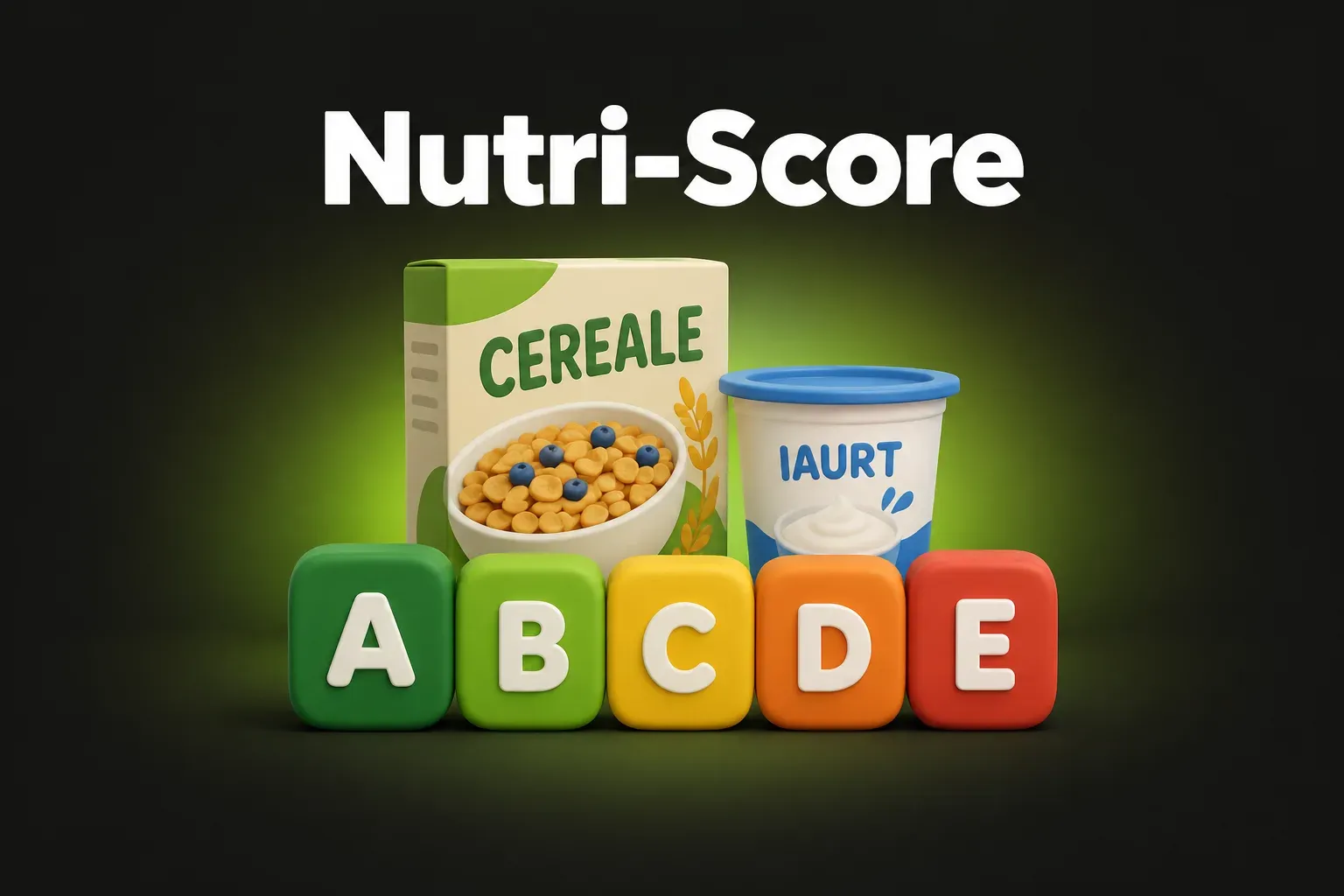
Nutri-Score is the label with five colored letters, from A (green) to E (red), that you see on more and more products in European supermarkets. It shows at a glance how healthy a food is based on its nutrients. So you can easily compare two similar products – for example, two boxes of cereal.
The short answer: Nutri-Score is worked out per 100 g or 100 ml of a product. Calories, sugars, saturated fat and salt lower the grade. Fiber, protein, fruits, vegetables and legumes raise it. It’s used officially in several European countries. It has one big limit: it doesn’t look at additives or processing. That’s why NutriSmart combines it with a check of additives.
What is Nutri-Score?
Nutri-Score was made in France by the team of Professor Serge Hercberg. It’s based on a food rating system first used in the United Kingdom. Companies can choose to use it. It’s an official label in France, Belgium, Spain, Germany, Switzerland, the Netherlands, Luxembourg and, more recently, Portugal.
The method is supported by the IARC, the World Health Organization’s cancer research agency. The IARC says the method has a strong science base and really helps people choose healthier food.
How Nutri-Score is calculated
The score is worked out per 100 g or 100 ml of a product, in three steps:
- Bad points for what’s best to limit: calories, sugars, saturated fat and salt. The more of them, the more points the product gets.
- Good points for what’s good to eat: fiber, protein, and fruits, vegetables, legumes and nuts.
- Final score = bad points minus good points. The lower the score, the better the grade.
For solid foods, under the rules updated in 2023, the score is turned into a letter like this:
| Score | Grade | What it means |
|---|---|---|
| 0 or less | A (dark green) | Very healthy nutrients |
| 1–2 | B (light green) | Good |
| 3–10 | C (yellow) | Average |
| 11–18 | D (orange) | Poor |
| 19 or more | E (red) | Very poor |
Drinks, fats and cheeses have slightly different rules. For example, water is the only drink that can get an A. And healthy oils like olive oil get better grades than other fats.
What changed in 2023
The rules were updated to be stricter on sugar and salt and fairer to healthy foods. Oily fish, nuts, olive oil and whole grains got better grades. Sweet drinks, including those with sweeteners, got worse ones.
What the research says
A European study followed over 500,000 adults in 10 countries for about 17 years. Some people ate mostly foods with poor nutrients (like D and E grades). They had a higher risk of death, including from cancer, gut diseases and lung diseases. This was compared with people who ate mostly foods with good nutrients (Deschasaux et al., BMJ, 2020).
What Nutri-Score doesn’t measure
Nutri-Score is useful, but it has limits:
- It ignores additives – a product with sweeteners, emulsifiers or colors can still get a good grade.
- It ignores processing – some ultra-processed foods get an A or B.
- It’s for comparing products of the same kind – a yogurt with a C isn’t always worse than a drink with a B.
- It’s calculated per 100 g, not per the portion you actually eat.
How NutriSmart uses Nutri-Score
In NutriSmart, Nutri-Score is turned into a score out of 100 and makes up 35% of a product’s health score. The other 65% comes from additives and risky ingredients – exactly the part Nutri-Score doesn’t cover. This way, a product with good nutrients but full of additives doesn’t automatically get a high score.
For the full details, read how products are rated in NutriSmart.
Missing data and estimates
Labels don’t have to show how much fruit, vegetables and legumes a product has. When it’s missing, we guess on the low side, so we don’t give a product a better grade than it deserves.
See any product’s score in seconds. With NutriSmart, you photograph the label or scan the barcode and see the Nutri-Score, every additive explained and the health score out of 100.Get the app free
The bottom line
Nutri-Score is a simple A–E label that shows how healthy a food’s nutrients are. It looks at calories, sugar, saturated fat, salt, fiber, protein, and fruits and vegetables. It’s a good tool for comparing similar products. But it ignores additives and processing, so it’s worth checking the ingredient list too.
FAQ
What is Nutri-Score?
Nutri-Score is a label on the front of food packs. It has five letters and colors, from A (dark green) to E (red). It shows how healthy a food is based on its nutrients. It was created by scientists in France and is used officially in several European countries.
How is Nutri-Score calculated?
It's worked out per 100 g or 100 ml of a product. The product gets bad points for calories, sugars, saturated fat and salt. It gets good points for fiber, protein, and fruits, vegetables and legumes (beans, lentils, peas). The difference gives a score, which is turned into a letter from A to E.
Is Nutri-Score used in the US?
No. Nutri-Score is a European label. In the US, the FDA has proposed its own front-of-package nutrition label instead. You may still see Nutri-Score on products imported from Europe.
Is a Nutri-Score A product healthy?
Not always. Nutri-Score only looks at nutrients. It doesn't look at additives, sweeteners or how processed a food is. So an ultra-processed product can still get a good grade. That's why NutriSmart combines Nutri-Score with a check of additives and risky ingredients.
What does Nutri-Score E mean?
E is the lowest grade. Per 100 g, the product has a lot of calories, sugar, saturated fat or salt, and little fiber, protein or fruit and vegetables. It doesn't mean you can never eat it. It just means it's best eaten rarely and in small portions.
How does NutriSmart use Nutri-Score?
NutriSmart works out the Nutri-Score from the nutrition facts on the label. It turns it into a score out of 100 and uses it for 35% of the product's health score. The other 65% comes from additives and risky ingredients.