Dextrin: What It Is, Uses and Is It Healthy?
What dextrin is, how it differs from maltodextrin and wheat dextrin fiber, why it's in coated nuts, chips and supplements, and if it's safe to eat.
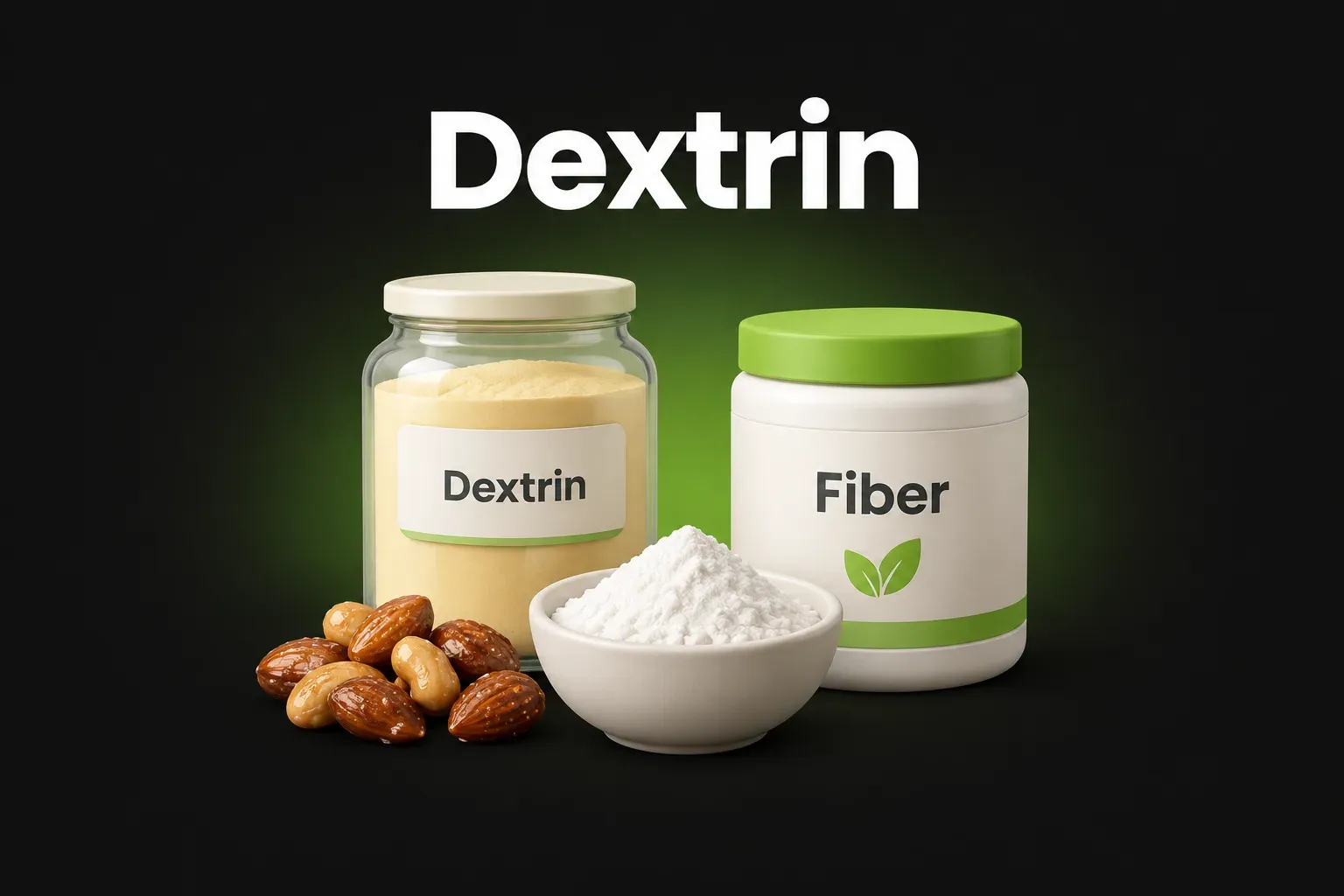
Dextrin appears on the labels of coated nuts, chips, crackers, cereal, candy coatings, sauces and many fiber supplements. It sounds a lot like dextrose and maltodextrin, and the names make it easy to mix them up.
The short answer: dextrin is starch that’s been partly broken down by dry heat. Regular dextrin is basically processed starch – about 4 calories per gram and quickly turned into glucose. Resistant dextrin (like wheat dextrin in fiber supplements) is a soluble fiber with about half the calories. Neither is harmful in normal amounts. In the EU, dextrin isn’t even classed as an additive, so NutriSmart doesn’t flag it.
What is dextrin?
Dextrin is made by roasting dry starch – from corn, wheat, potatoes or tapioca – sometimes with a little acid. The heat breaks the long starch chains into shorter pieces. Depending on how it’s made, you get:
- White dextrin – lightly processed, used in coatings and glazes
- Yellow dextrin and British gum – roasted longer, darker, used mostly as glue
- Resistant dextrin – rearranged so that most of it can’t be digested, used as a fiber
Fun fact: the glue on envelopes and stamps is often dextrin.
Dextrin vs maltodextrin vs dextrose
| Ingredient | How it’s made | How your body handles it | Calories per gram |
|---|---|---|---|
| Dextrose | Starch fully broken into glucose | Absorbed very fast | 4 |
| Maltodextrin | Starch broken down with water and enzymes | Digested very fast | 4 |
| Dextrin | Starch roasted dry, sometimes with acid | Digested like starch | about 4 |
| Resistant dextrin / wheat dextrin | Roasted and rearranged | Mostly not digested – acts as fiber | about 2 |
Where you’ll find dextrin
- Coated and roasted nuts – helps salt and spices stick
- Chips, crackers and pretzels – coatings and seasonings
- Breakfast cereal and candy coatings – a crisp, shiny layer
- Sauces, soups and gravies – a light thickener
- Fried foods – crispy batter
- Fiber supplements and “added fiber” foods – as resistant dextrin or wheat dextrin
Is dextrin safe?
Regular dextrin
- EU: under the EU additives law, roasted or dextrinated starch is not a food additive – it’s treated as a normal food ingredient (EU Regulation 1333/2008). That’s why it has no E number. NutriSmart doesn’t flag it either.
- US: the FDA lists dextrin as generally recognized as safe (21 CFR 184.1277).
Nutritionally, it’s processed starch: it adds calories and raises blood sugar, like white flour. The amounts used in coatings are small.
Resistant dextrin (wheat dextrin)
Resistant dextrin is a soluble fiber. The FDA lets companies count it as dietary fiber on the label (FDA). Like other fibers, it can help you feel full and feed gut bacteria. In large amounts it can cause gas and bloating, so start with small doses. Read more about fiber supplements and high-fiber foods.
Gluten
Wheat dextrin is processed so much that very little gluten is left, and many brands meet the gluten-free limit of 20 ppm. If you have celiac disease, buy products that clearly say gluten-free.
How to read labels with dextrin
- “Dextrin” in a coating or sauce is processed starch – count it as carbs.
- “Resistant dextrin”, “soluble corn fiber” or “wheat dextrin” are fibers. Read about soluble corn fiber and polydextrose.
- Don’t confuse it with dextrose, which is pure sugar.
Check labels with dextrin in seconds. With NutriSmart, you photograph the ingredient list or scan the barcode, and the app shows you which ingredients are additives, what each one does and what its risks are – and it counts sugars like dextrose and glucose syrup as sugar. Turn on an alert for any additive you want to avoid. You’ll also see a health score out of 100 for every product.Get the app free
You can also read about modified food starch, which is starch changed with chemicals.
The bottom line
Dextrin is starch partly broken down by dry heat. Regular dextrin is basically processed starch – about 4 calories per gram, used in coatings, sauces and snacks – and it isn’t harmful in the small amounts used. Resistant dextrin, like wheat dextrin, is a soluble fiber. In the EU dextrin isn’t an additive at all, so it’s not one to worry about – but don’t confuse it with dextrose, which is pure sugar.
FAQ
What is dextrin?
Dextrin is starch that has been partly broken down by dry heat, often with a little acid. It's a white or yellow powder made from corn, wheat, potato or tapioca starch. It's used as a coating, binder and thickener in foods, and as a glue in envelopes and stamps.
Is dextrin the same as maltodextrin?
No, but they're related. Both come from starch. Maltodextrin is made with water and enzymes and is digested very fast. Dextrin is made with dry heat and acid; some kinds are digested like starch, while "resistant dextrin" acts like fiber.
Is dextrin healthy?
Regular dextrin is basically processed starch: about 4 calories per gram, quickly turned into glucose. It isn't harmful in the small amounts used in foods. Resistant dextrin (like wheat dextrin fiber supplements) is a soluble fiber with about half the calories.
Is wheat dextrin gluten-free?
Wheat dextrin is processed so much that very little gluten is left, and many brands say their product meets the gluten-free limit of 20 ppm. If you have celiac disease, check that the label says gluten-free.
Is dextrin an additive?
In the EU, roasted starch dextrins are not considered food additives and don't have an E number – they're treated as a food ingredient like starch. That's why NutriSmart doesn't flag dextrin as an additive.
Does dextrin raise blood sugar?
Regular dextrin does, much like starch. Resistant dextrin raises blood sugar very little because most of it isn't digested.