Invert Sugar: What It Is and Is It Worse Than Sugar?
What invert sugar (invert syrup) is, how it's made, why it's in cookies, candy and drinks, its calories, and how it compares with sugar, honey and HFCS.
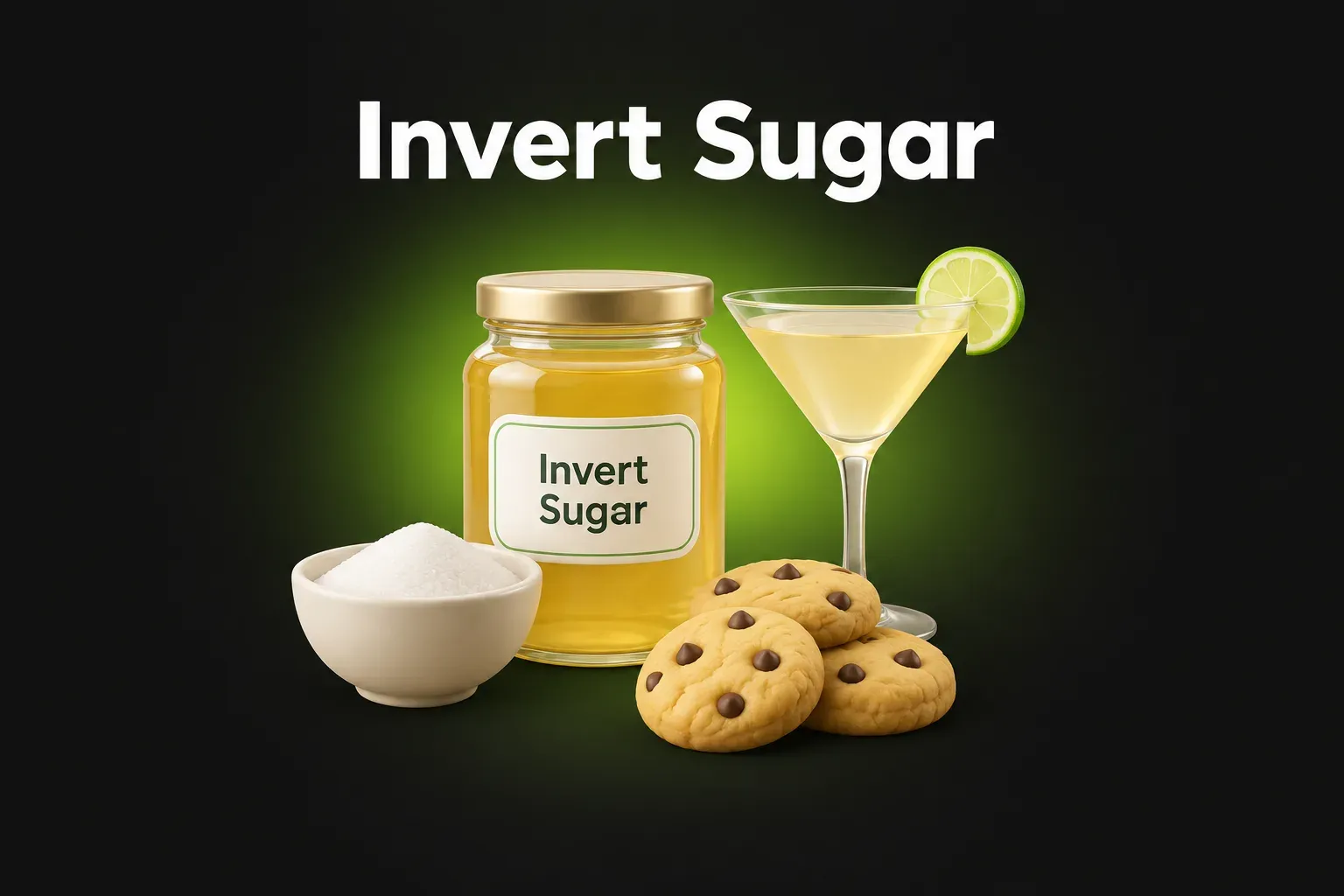
Invert sugar – also called invert syrup or invert sugar syrup – shows up on labels of soft cookies, cakes, fondant, chocolates, cereal bars, liqueurs and some soft drinks. It sounds like a special ingredient, but it’s really just table sugar in a different form.
The short answer: invert sugar is table sugar split into glucose and fructose. It’s a little sweeter than sugar, keeps baked goods soft and moist and stops candy from going grainy. It has about the same calories as sugar (about 60–65 per tablespoon of syrup) and the same 50/50 mix of glucose and fructose. It’s not worse than sugar – but not better either. It’s an added sugar, so count it like one.
What is invert sugar?
Table sugar (sucrose) is made of two smaller sugars stuck together: glucose and fructose. To make invert sugar, sugar is dissolved in water and then:
- heated with a little acid (like citric acid), or
- treated with an enzyme called invertase – the same enzyme bees use to make honey.
This splits the sucrose into free glucose and fructose. The name “invert” comes from light: after the split, the syrup bends light the other way.
There are two main types:
- Fully inverted syrup – almost all the sucrose is split
- Partly inverted syrup – some sucrose is left, like golden syrup
Honey is a natural invert sugar: bees use invertase to split the sucrose in nectar.
Why is invert sugar used in food?
- It keeps baked goods soft: it holds on to water, so cookies and cakes stay moist for longer.
- It stops crystals: fondant, truffles, ice cream and candy stay smooth.
- It’s sweeter: about 1.2–1.3 times sweeter than sugar, so less is needed.
- It browns well in baking.
- It dissolves easily in cold drinks and cocktails.
You’ll find it in soft cookies and cakes, chocolates and pralines, fondant and icing, cereal bars, ice cream, liqueurs and cocktail syrups, and some soft drinks. In Germany, “Invertzuckercreme” (once called artificial honey) is sold as a spread.
Invert sugar nutrition
Approximate values. Invert sugar syrups usually contain 70–80% sugar and the rest water.
| Amount | Calories | Sugar |
|---|---|---|
| 1 teaspoon (7 g) | about 21 kcal | about 5 g |
| 1 tablespoon (20 g) | about 60–65 kcal | about 15–16 g |
| 100 g | about 300–330 kcal | about 75–80 g |
It has no fiber, protein, vitamins or minerals worth mentioning.
Invert sugar vs sugar, honey and HFCS
| Sweetener | Made of | Calories per tbsp | Source |
|---|---|---|---|
| Table sugar | Sucrose (glucose + fructose joined) | about 48 (12 g) | Sugar cane or beet |
| Invert sugar syrup | Free glucose and fructose, about 50/50 | about 60–65 (20 g) | Sugar cane or beet |
| Honey | Mostly fructose and glucose | about 64 (21 g) | Bees |
| High fructose corn syrup | Glucose and fructose (42–55% fructose) | about 53 (19 g) | Corn |
| Corn syrup | Mostly glucose and maltose | about 62 (22 g) | Corn |
A tablespoon of syrup weighs more than a tablespoon of sugar, so the calories per spoon look higher. The sugar in each of them has the same 4 calories per gram – syrups just also contain some water.
Your body splits table sugar into glucose and fructose anyway, within minutes. So invert sugar, sugar and honey end up almost the same once you eat them.
Is invert sugar bad for you?
Invert sugar isn’t toxic. There’s no proof it’s worse than table sugar. The problem is that it’s added sugar, and most people eat too much of it. High intake of added sugar is linked to weight gain, type 2 diabetes, fatty liver, heart disease and tooth decay.
- Fructose: about half of invert sugar is fructose. Large amounts of fructose, mostly from sweet drinks, are linked to fatty liver and higher blood fats – the same concern as with sugar and HFCS.
- Daily limit: the American Heart Association suggests no more than 25 g of added sugar a day for most women and 36 g for most men (AHA). The WHO recommends keeping free sugars below 10% of daily calories, ideally 5% (WHO).
- Blood sugar: it raises blood sugar about as much as table sugar. If you have diabetes, count it like sugar.
How to spot invert sugar on labels
- Look for invert sugar, invert syrup, invert sugar syrup, partially inverted sugar syrup and golden syrup.
- Check “added sugars” on US labels – invert sugar counts.
- Count all the sweeteners: many cookies and bars use several (sugar, invert syrup, glucose syrup, dextrose).
- Choose products with less sugar per 100 g when you compare two similar items.
Spot invert sugar on any label in seconds. With NutriSmart, you photograph the ingredient list or scan the barcode, and the app tells you right away if the product has invert sugar – it counts it as sugar. Turn on an alert for sugar, and the app warns you every time a product you scan contains it. You’ll also see every other additive, the risks of each one and a health score out of 100.Get the app free
You can also read about other sweeteners: agave syrup, coconut sugar and tapioca syrup.
The bottom line
Invert sugar is table sugar split into glucose and fructose. It keeps cookies soft and candy smooth and is a little sweeter than sugar. It has about the same calories and the same effect on your body as sugar or honey. It isn’t worse than sugar, but it isn’t healthier either – it’s added sugar, so keep the total low.
FAQ
What is invert sugar?
Invert sugar is table sugar (sucrose) that has been split into its two parts, glucose and fructose, using heat with acid or an enzyme. The result is a smooth syrup that's a little sweeter than sugar and doesn't form crystals.
Is invert sugar bad for you?
It's no worse than table sugar, but it isn't better either. It's an added sugar with about the same calories and the same 50/50 mix of glucose and fructose. Like all added sugar, it's best kept low.
Is invert sugar the same as honey?
Not quite, but they're similar. Honey is a natural invert sugar made by bees: mostly fructose and glucose. Invert sugar syrup is made in a factory from table sugar. Both count as added sugar.
Is invert sugar the same as high fructose corn syrup?
No, but they're close. Both are mixes of glucose and fructose. Invert sugar comes from cane or beet sugar and is about half fructose; HFCS comes from corn and is 42–55% fructose.
Why is invert sugar used in cookies and candy?
It keeps baked goods soft and moist for longer, stops candy and fondant from getting grainy, browns well and dissolves easily in cold drinks.
How many calories are in invert sugar syrup?
A typical invert sugar syrup has about 300–330 calories per 100 g, or about 60–65 calories per tablespoon, depending on how much water it contains.