Are Pork Rinds Healthy? Protein, Sodium and 8 Brands
Are pork rinds healthy? Carbs, protein quality, fat and sodium per ounce, 8 brands compared, flavors with MSG and dyes, and pork rinds vs chips.
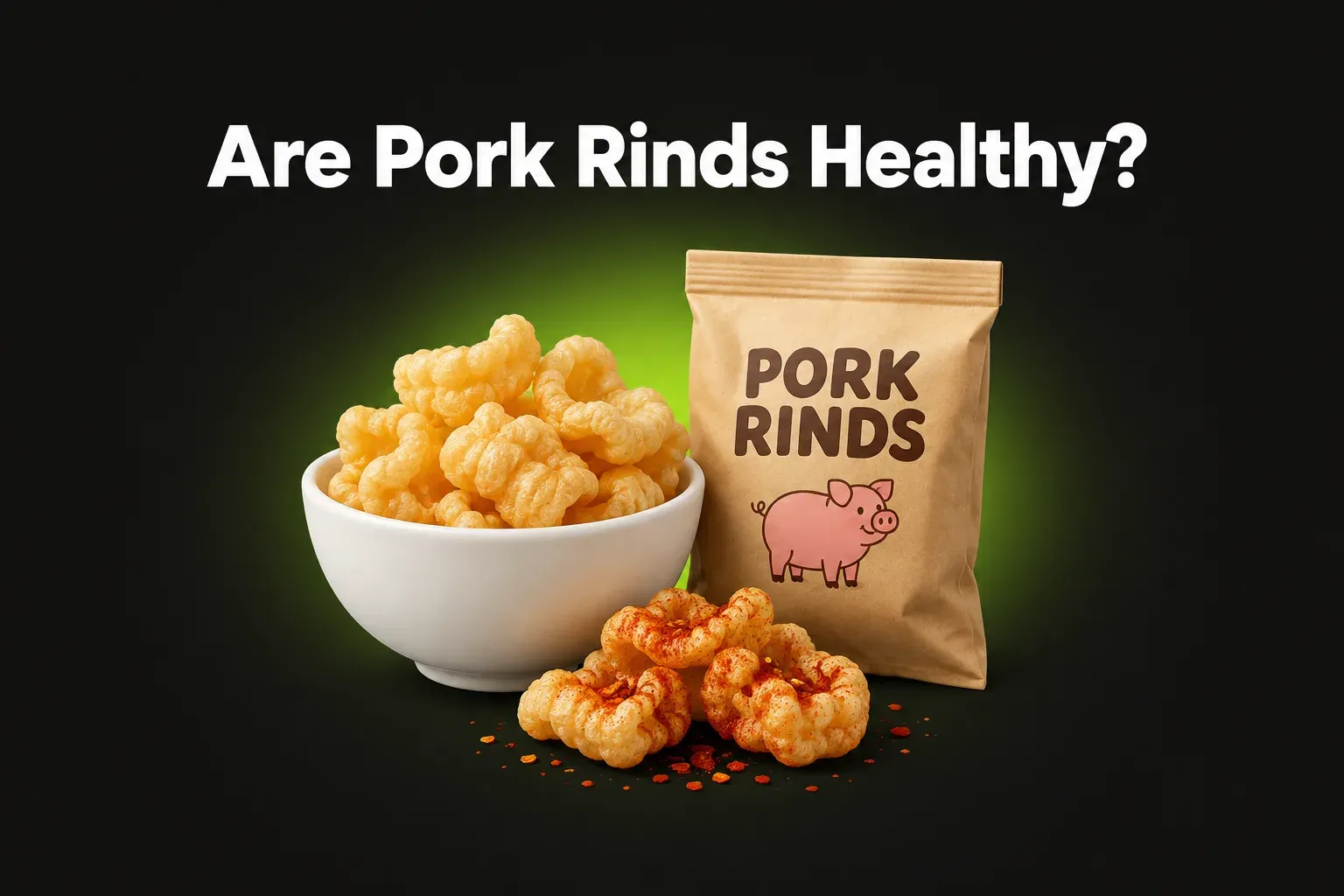
Pork rinds, also called chicharrones, crunch like chips but have no carbs. That’s why keto fans love them. But are pork rinds healthy?
The short answer: they’re okay as a small snack, but they’re not a health food. One ounce (28 g) of plain pork rinds has about 155 calories, 0 g of carbs and 17 g of protein. That sounds great. But the protein is mostly collagen, which your body can’t use as well as protein from meat, eggs or milk. The same ounce has about 520 mg of sodium and 3 g of saturated fat. Flavored bags can add MSG, artificial dyes and sugar. Pick a plain bag with just pork skins and salt, and eat ½–1 oz at a time.
What’s in 1 oz of pork rinds
Pork rinds are pig skin. The skin is boiled, dried and then fried or baked. The heat makes it puff up into light, crunchy pieces.
Here is what the USDA lists for 1 oz (28 g) of plain pork skins:
| Per 1 oz (28 g) | Amount |
|---|---|
| Calories | 154 |
| Protein | 17.4 g |
| Fat | 8.9 g |
| Saturated fat | 3.2 g |
| Monounsaturated fat | 4.2 g |
| Carbs | 0 g |
| Sodium | 516 mg |
| Cholesterol | 27 mg |
Source: USDA FoodData Central, “Snacks, pork skins, plain”. Values per 100 g, converted to 1 oz and rounded.
What stands out:
- Zero carbs. That’s why pork rinds are so popular on the keto diet.
- Lots of protein. Per ounce, pork rinds have about twice as much protein as cooked chicken breast. But the type of protein matters, as you’ll see below.
- Salt. One ounce gives you about 22% of the daily limit of 2,300 mg.
- Almost no vitamins or minerals. Most labels show 0% for calcium, iron and potassium.
Most brands list a serving as ½ oz (14 g). So a 1 oz snack bag is two servings, and a 4 oz bag is eight.
8 popular pork rind brands compared
Plain pork rinds are all quite similar. The biggest differences are in sodium and in how they’re cooked. Here are the numbers per ½ oz (14 g) label serving.
| Product | Calories | Protein | Fat | Sat. fat | Sodium | Ingredients |
|---|---|---|---|---|---|---|
| Golden Flake Old Fashioned (Utz) | 80 | 8 g | 6 g | 2 g | 190 mg | Fried pork skins, maltodextrin, salt, brown sugar, MSG, onion, garlic, hydrolyzed corn protein, yeast, spices, smoke flavor |
| Mac’s Original | 80 | 8 g | – * | – * | 150 mg | Fried pork skins, salt, natural smoke flavor; fried in pork fat |
| Epic Baked Pink Himalayan & Sea Salt | 70 | 11 g | 2.5 g | 0.5 g | 250 mg | Baked pork skins, pork fat, pink Himalayan sea salt, sea salt |
| 4505 Classic Chili & Salt | 80 | 7 g | 6 g | 2 g | 140 mg | Pork rinds, salt, coconut palm sugar, spices; fried in pork fat |
| Southern Recipe Original | 80 | 9 g | 5 g | 2 g | 270 mg | Pork rinds, salt |
| Baken‑Ets Original | 80 | 7 g | 6 g | 2.5 g | 220 mg | Fried pork skins, salt |
| Pork King Good Original | 90 | 8 g | 6 g | 2.5 g | 170 mg | Pork rinds (cooked in pork fat), salt |
| Southern Recipe Original Pork Cracklins | 80 | 7 g | 6 g | 1.5 g | 360 mg | Pork fat with attached skin, salt |
Sources: nutrition labels on the brand sites – Golden Flake, Epic, 4505, Southern Recipe rinds and cracklins, Pork King Good. Mac’s and Baken-Ets: label photos on Open Food Facts (Mac’s, Baken-Ets). *The fat lines were not readable on the Mac’s label photo. The 4505 label on the brand site is an older version, so numbers on newer bags may differ a little.
What stands out:
- Shortest labels: Southern Recipe Original and Baken-Ets Original have just pork skins and salt. Pork King Good adds only the pork fat it’s cooked in.
- “Old fashioned” doesn’t always mean plain. Golden Flake Old Fashioned adds MSG, maltodextrin and brown sugar. Always read the ingredients.
- Least sodium: 4505 Classic Chili & Salt (140 mg) and Mac’s (150 mg). Southern Recipe Original has almost twice as much (270 mg).
- Least fat and most protein: Epic’s baked rinds, with 2.5 g of fat and 11 g of protein per serving.
- Cracklins are skin with fat still on it. They’re harder and crunchier. They also have the most sodium in our list (360 mg).
The protein catch: it’s mostly collagen
Pig skin is made mostly of collagen. That’s the protein that holds skin, tendons and bones together. Gelatin is collagen too, just cooked.
Your body builds and repairs muscle from amino acids, the building blocks of protein. Nine of them are “essential.” That means you must get them from food. Collagen has very little of some of them.
The USDA numbers show the gap. Per gram of protein, pork skins have:
- about one-sixth of the tryptophan in chicken breast,
- about a quarter of the methionine,
- and four times as much glycine, an amino acid your body can make on its own.
Scientists call collagen an incomplete protein because it lacks tryptophan (Paul et al., Nutrients, 2019).
You can see this on the labels. In the US, the % Daily Value for protein must be corrected for protein quality (21 CFR 101.9). Southern Recipe Original lists 9 g of protein but only 2% of the Daily Value. Nine grams of egg or milk protein would count for about 18%. Epic, Mac’s, 4505, Golden Flake and Pork King Good print “not a significant source of protein” right next to 7–11 g.
Does collagen fill you up? It may. In a Dutch study, 24 healthy adults ate a breakfast custard made with different proteins. After a gelatin breakfast, they ate about 20% less at lunch than after casein, soy or one kind of whey protein (Veldhorst et al., Clinical Nutrition, 2009). In another study, 23 adults spent 36 hours in a test room. Gelatin curbed hunger more than casein, a milk protein. But their bodies kept less protein on the gelatin diet (Hochstenbach-Waelen et al., Journal of Nutrition, 2009).
Bottom line on protein: pork rinds can help you feel full. But don’t count them as a main protein source. Get most of your protein from meat, fish, eggs, dairy, beans or tofu. Our protein calculator shows how much you need.
Fried in lard or oil?
Many pork rinds are cooked in lard, the fat that melts out of the pig. Mac’s, 4505 and Pork King Good say so on the bag. Epic bakes its rinds with a light spray of lard. That cuts the fat to 2.5 g per serving. Many flavored Southern Recipe bags list sunflower oil instead.
The fat in plain pork rinds is about half monounsaturated – the same type as in olive oil. About a third is saturated. One ounce has 3.2 g of saturated fat, about 16% of the Daily Value.
Is that a problem? A Cochrane review combined 15 trials with over 56,000 adults. Each trial lasted at least two years. People who ate less saturated fat had 17% fewer heart and blood vessel problems, counted together. Their risk of dying did not change (Hooper et al., Cochrane Database of Systematic Reviews, 2020). So a bag now and then is fine. A bag every day adds up. Read more about animal fats in is beef tallow healthy?
Watch the salt
The daily limit for sodium is 2,300 mg (FDA). Pork rinds are so light that it’s easy to eat a whole bag.
- A 4 oz bag of Southern Recipe Original has 8 servings. That’s about 2,160 mg of sodium – almost a full day’s limit.
- The same size bag of Mac’s has about 1,200 mg.
Too much salt raises blood pressure. A big review combined 34 trials with over 3,000 people. When they ate about 4.4 g less salt a day for at least four weeks, their top blood pressure number fell by about 4 points (He et al., BMJ, 2013).
Tip: pour ½–1 oz into a bowl and put the bag away. If you watch your blood pressure, pick a brand with 200 mg or less per serving.
Flavored pork rinds: MSG, dyes and sugar
Plain rinds have two or three ingredients. Flavored ones can have more than ten. Here’s what we found on US labels:
- Baken-Ets Hot ’N Spicy: corn maltodextrin, MSG (monosodium glutamate), dextrose and three artificial colors – Red 40 lake, Yellow 6 lake and Blue 1 lake. Sodium goes up to 300 mg per serving (Open Food Facts).
- Kroger Barbeque: torula yeast, sugar, modified food starch and MSG (Open Food Facts).
- Utz Hot & Spicy: hydrolyzed soy, corn and wheat proteins, dextrose and sugar (Open Food Facts). So not every flavored rind is gluten-free.
- Southern Recipe Salt & Pepper: sunflower oil, maltodextrin, yeast extract and natural flavors (Southern Recipe).
- Pork King Good dessert flavors, like Birthday Cake, add turbinado sugar (Pork King Good).
The USDA lists barbecue pork rinds at 757 mg of sodium per ounce. That’s about 240 mg more than plain.
What research says about MSG. Regulators say normal amounts are safe. A trial at several US clinics tested 130 adults who thought they reacted to MSG. On one day they got 5 g of MSG without food. On another day they got a fake dose. More people had symptoms after the MSG. But most reactions didn’t come back when people were tested again (Geha et al., Journal of Allergy and Clinical Immunology, 2000). Animal studies raise more questions. A 2023 review looked at studies in mice. MSG damaged nerve cells and hurt short-term memory. The most common dose was 4 g per kg of body weight, often given as a shot. That is far more than people get from food (Ankul et al., Frontiers in Pharmacology, 2023).
What research says about the dyes. In a UK trial, about 300 children ages 3 and 8–9 got fruit drinks. Some drinks had a mix of artificial colors and a preservative. Others had none. Nobody knew which drink was which. The drinks with additives made the children a little more hyperactive (McCann et al., The Lancet, 2007). In a 2022 study, mice ate food with Red 40 every day for 12 weeks. The dose matched what is found in common foods. The mice got mild inflammation in the gut. Whether this happens in people is not known yet (Kwon et al., Nature Communications, 2022).
Why animal studies matter: mice and rats share most of our genes and body processes. And testing a suspect additive on people would put their health at risk. Proof in humans is still missing. But several labs see similar warning signs. So as a precaution, pick plain or simply seasoned rinds, and limit bags with MSG and artificial colors – especially for kids.
Pork rinds vs chips and other snacks
| Snack (1 oz / 28 g) | Calories | Protein | Carbs | Sat. fat | Sodium |
|---|---|---|---|---|---|
| Pork rinds, plain | 154 | 17.4 g | 0 g | 3.2 g | 516 mg |
| Pork rinds, barbecue | 153 | 16.4 g | 0.5 g | 3.3 g | 757 mg |
| Potato chips, salted | 151 | 1.8 g | 15.3 g | 1.0 g | 149 mg |
| Beef jerky | 116 | 9.4 g | 3.1 g | 3.1 g | 505 mg |
| Almonds, dry roasted, salted | 170 | 6.0 g | 6.0 g | 1.2 g | 66 mg |
Source: USDA FoodData Central – pork rinds, plain, pork rinds, barbecue, potato chips, beef jerky, almonds. Values per 100 g, converted to 1 oz and rounded.
What stands out:
- Calories are about the same as chips. Pork rinds are not a “light” snack.
- Pork rinds win on carbs and protein amount. They won’t spike your blood sugar.
- Chips win on sodium. Plain pork rinds have more than three times as much salt.
- Almonds give fiber, healthy fats and far less salt.
So pork rinds are a fair swap for chips on a low-carb diet, but not a better snack in every way. For more ideas, see our guides to the healthiest chips, high-protein snacks and is beef jerky healthy? Curious what’s in stacked chips? See Pringles ingredients.
How to pick a healthier bag
- Read the ingredients. The best bags list just pork skins and salt (and maybe the fat they’re fried in).
- Compare sodium. Aim for 200 mg or less per ½ oz serving.
- Skip MSG and artificial colors like Red 40, Yellow 6 and Blue 1.
- Check for sugar. BBQ, sweet and dessert flavors often add sugar, dextrose or maltodextrin.
- Need gluten-free? Plain rinds usually are, but some flavors contain wheat.
- Stick to ½–1 oz. Pair it with vegetables, cheese or eggs for a fuller snack.
Check your pork rinds before you buy. With NutriSmart, you photograph the label or scan the barcode. The app lists the sweeteners, preservatives and colors, explains the risks of each one and gives the product a health score out of 100. It also tells you right away if a snack is ultra-processed and which ingredients make it so. Set an alert for MSG or Red 40, and the app warns you on every scanned product that contains it.Get the app free
The bottom line
Pork rinds are a crunchy, zero-carb snack that fits keto. One ounce has about as many calories as chips, but far more protein. The catch is that the protein is mostly collagen, which doesn’t count much for building muscle. Pork rinds also have a lot of salt and some saturated fat. Flavored bags can add MSG, artificial dyes and sugar. Pick a plain bag with only pork skins and salt, eat ½–1 oz at a time, and get your main protein from other foods.
FAQ
Are pork rinds healthy?
They're okay as a small snack, but not a health food. One ounce has 0 g of carbs and about 17 g of protein. But that protein is mostly collagen, which is low quality, and the same ounce has about 520 mg of sodium.
Are pork rinds good for keto?
Yes. Plain pork rinds have 0 g of carbs, so they fit a keto or low-carb diet. Check flavored bags, which can add sugar, dextrose or maltodextrin.
Is the protein in pork rinds good protein?
Not really. Most of it is collagen, which has very little tryptophan and too little of some other amino acids your body can't make. That's why some labels print "not a significant source of protein" next to 7–11 g of protein.
Are pork rinds healthier than chips?
In some ways. Per ounce, they have about the same calories as potato chips, but no carbs and much more protein. They also have more than three times the sodium and more saturated fat.
Are pork rinds fried in lard?
Many are. Mac's, 4505 and Pork King Good say on the bag that they cook the skins in pork fat, which is lard. Epic bakes its rinds with a light spray of lard, and many Southern Recipe flavors list sunflower oil.
What's the difference between pork rinds and cracklins?
Pork rinds are just the skin, fried until they puff up. Cracklins are skin with a layer of fat still attached. They are crunchier and harder, with a bit more fat and a bit less protein.