Are Smoothies Healthy? Sugar, Fiber and 10 Drinks Compared
Are smoothies healthy? Fruit sugar vs fiber, liquid calories and fullness, 10 bottled and chain smoothies compared, and how to blend a balanced one.
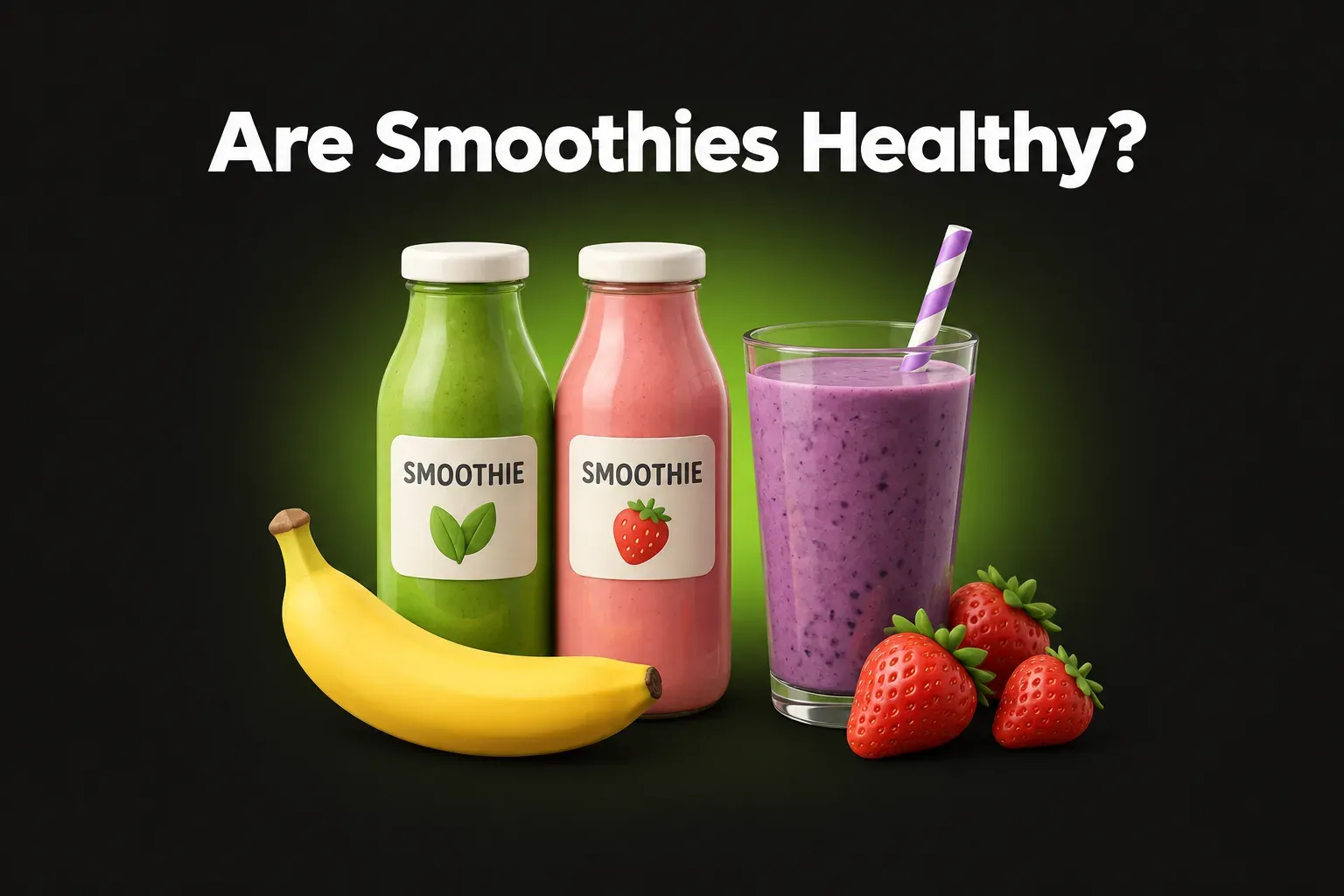
Smoothies look like the healthiest thing on any menu. They’re full of fruit, often green, and easy to grab on the go. But are smoothies healthy, or just sugar in a cup?
The short answer: it depends on what goes in the blender. A homemade smoothie with fruit, greens, protein and a little fat can be a healthy breakfast. It keeps the fiber that juice loses. But many bottled and chain smoothies pack about 45–70 g of sugar in one bottle or cup, with little protein. Some chain smoothies even add sugar or sherbet. And because you drink it, a smoothie fills you up less than the same fruit you chew.
Smoothie vs juice: why fiber matters
When you juice fruit, you press out the liquid and throw away most of the pulp. The pulp holds most of the fiber. When you blend fruit, the whole fruit stays in the cup. So a smoothie keeps the fiber.
Fiber matters because it slows down sugar. It also helps you feel full. Read more in our list of high fiber foods.
Blending doesn’t seem to harm fruit the way juicing does. Two small studies even found the opposite:
- Blended vs whole fruit. 20 healthy students ate apples and blackberries, either whole or blended. Blood sugar peaked lower after the blended fruit (Crummett et al., Nutrients, 2022). The authors think the ground-up blackberry seeds may have helped.
- Blender drink vs whole fruit. In a UK study, people drank mixed fruit made in a strong blender. It raised blood sugar less than the same whole fruit. For mango, there was no difference. The reason is still unclear (Redfern et al., Nutrition & Diabetes, 2017).
Juice is another story. A large Harvard study followed over 187,000 health workers for many years. Eating more whole fruit, like blueberries, grapes and apples, was linked to a lower risk of type 2 diabetes. But drinking more fruit juice was linked to a higher risk (Muraki et al., BMJ, 2013). See is orange juice healthy? for more.
Here’s the catch: many bottled smoothies are mostly juice. In a Naked Green Machine, apple juice is the first ingredient. The World Health Organization counts the sugar in fruit juice as “free sugar” – the kind we should eat less of (WHO, 2015). But US labels don’t count it as added sugar.
Do smoothies fill you up?
Not as well as food you chew. You can drink a smoothie in two minutes. Your body may not notice those calories the same way.
- Soda vs jelly beans. 15 adults got an extra 450 calories a day for 4 weeks. One time it came as soda, another time as jelly beans. With jelly beans, they ate less at other meals. With soda, they didn’t. They gained weight only on the soda (DiMeglio & Mattes, International Journal of Obesity, 2000).
- Apple, applesauce or apple juice. 58 adults ate an apple snack before lunch. It came as a whole apple, applesauce or apple juice. Each had the same 125 calories. The whole apple filled them up most. It cut their total lunch calories by 15% compared with no snack. The juice did the least (Flood-Obbagy & Rolls, Appetite, 2009).
- An older test. 10 adults ate apples, applesauce or apple juice. They drank the juice 11 times faster than they ate the apples. The juice was the least filling, and the whole apples the most. Applesauce – blended fruit, like a smoothie – was in between. After the juice, blood sugar dropped sharply later on. That didn’t happen after whole apples (Haber et al., Lancet, 1977).
One study found a smaller gap. A bowl of fresh fruit felt more filling than a smoothie made from the same fruit. But people ate about the same amount at their next meal (Rogers & Shahrokni, Nutrients, 2018). The study was funded by smoothie maker Innocent Drinks.
The lesson: a smoothie works best as a meal, not as a drink next to your meal.
Bottled smoothies: what the label says
Naked is one of the best-known bottled smoothie brands in the US. Its labels say “no added sugar.” That’s true by US rules. But a 15.2 oz (450 ml) bottle of Green Machine still has 49 g of sugar – about 12 teaspoons. The WHO says keeping free sugar under about 25 g a day brings extra health benefits.
The first ingredient is apple juice from concentrate, then mango, kiwi and banana puree. The greens come later in the list. Most are powders, like spinach and kale powder. Each bottle has 6 g of fiber. But part of it is added inulin, a fiber often made from chicory root.
Bolthouse Farms Green Goodness is similar. It starts with pineapple and apple juice. A 15.2 oz bottle has 240 calories, about 44–47 g of sugar and 2–3 g of fiber. The numbers differ a little between label photos and store listings.
Both are better than soda. They have vitamins and some fiber. But they’re closer to juice than to a meal. They also give you only 2 g of protein.
Chain smoothies: Smoothie King and Jamba
Chain smoothies come in big cups. At Smoothie King, the smallest size of most smoothies is 20 oz (590 ml). Some recipes add sugar.
- Smoothie King Angel Food (20 oz) is strawberries, bananas, nonfat milk and turbinado (a raw cane sugar). It has 71 g of sugar. Smoothie King lists 50 g of it as added sugar. The American Heart Association’s daily limit for added sugar is 25 g for women and 36 g for men (Johnson et al., Circulation, 2009).
- Jamba Mango-A-Go-Go (small, 16 oz) has 66 g of sugar, 2 g of fiber and 1 g of protein. It’s made with pineapple sherbet, which lists sugar and corn syrup.
- Jamba Strawberries Wild (small) has 49 g of sugar. It’s made with nonfat frozen yogurt that lists sugar and corn syrup.
Jamba’s sherbets and frozen yogurt also contain carrageenan, a thickener from seaweed. US rules allow it, but independent studies raise questions:
- In mice: a low dose (10 mg per liter of drinking water) made blood sugar control worse. It also blocked insulin signals in the liver (Bhattacharyya et al., Diabetologia, 2012).
- In people: 20 young men took 250 mg of carrageenan or a dummy pill twice a day, for two weeks each. Across the whole group, there was no clear change. But in the men who were overweight, carrageenan made their bodies respond worse to insulin (Wagner et al., BMC Medicine, 2024).
Why do mouse studies matter? Mice share most of our genes and body processes. And giving people a possibly harmful additive for years would put their health at risk. Still, strong proof in humans is missing. Since more than one lab sees similar signals, it’s sensible to limit carrageenan as a precaution.
The good news: both chains also sell better options. Smoothie King’s Power Meal Blueberry Raspberry has 0 g of added sugar, 20 g of protein and 8 g of fiber. At Jamba, a small Protein Berry Workout with whey has 19 g of protein and less sugar than most fruit-only options.
10 bottled and chain smoothies compared
| Smoothie | Calories | Sugar (added) | Fiber | Protein |
|---|---|---|---|---|
| Naked Green Machine (15.2 oz) | 240 | 49 g (0 g) | 6 g | 2 g |
| Naked Double Berry Protein (15.2 oz) | 220 | 24 g (0 g) | 6 g | 20 g |
| Bolthouse Farms Green Goodness (15.2 oz) | 240 | 44–47 g (0 g) | 2–3 g | 2 g |
| Smoothie King Angel Food (20 oz) | 350 | 71 g (50 g) | 4 g | 5 g |
| Smoothie King Strawberry X-treme (20 oz) | 300 | 68 g (52 g) | 4 g | 1 g |
| Smoothie King Vegan Mango Kale (20 oz) | 320 | 45 g (0 g) | 7 g | 10 g |
| Smoothie King Power Meal Blueberry Raspberry (20 oz) | 320 | 29 g (0 g) | 8 g | 20 g |
| Jamba Mango-A-Go-Go (small, 16 oz) | 295 | 66 g (not listed) | 2 g | 1 g |
| Jamba Strawberries Wild (small, 16 oz) | 260 | 49 g (not listed) | 4 g | 3 g |
| Jamba Protein Berry Workout, whey (small, 16 oz) | 260 | 34 g (not listed) | 3 g | 19 g |
Sources: Naked product pages (Green Machine, Double Berry Protein). Bolthouse Farms Green Goodness: label on Open Food Facts and store listings (they differ slightly). Smoothie King menu pages: Angel Food, Strawberry X-treme, Vegan Mango Kale, Power Meal Blueberry Raspberry. Jamba: nutrition guide, October 2026; Jamba doesn’t list added sugar. Recipes can change, so check the current label or menu.
What stands out:
- Most fruit-only smoothies have about 45–70 g of sugar and only 1–5 g of protein.
- The two Smoothie King Fruit Classics in the table list 50 g or more of added sugar.
- Protein versions are better. Naked Double Berry Protein has half the sugar of Green Machine and 10 times the protein. It’s closer to a real meal.
What about protein smoothies?
Protein helps you feel full for longer. So a smoothie with 15–25 g of protein makes a much better meal than a fruit-only one.
Read the label, though. Naked’s Double Berry Protein gets its protein from soy protein. It also contains stevia extract, a sweetener with no calories. Stevia doesn’t raise blood sugar. But one rat study raises a question. Young rats got a low dose of a purified stevia sweetener (Reb A) in their water. The dose was 2–3 mg per kg of body weight, for 9 weeks. That’s within the amount regulators call safe. It didn’t change their weight or blood sugar. But it changed their gut bacteria. It also lowered the activity of some genes in the brain’s reward system (Nettleton et al., Nutrients, 2019).
Why do rat studies matter? Rats share most of our genes and body processes. And testing a sweetener on people for years could put their health at risk. Proof in people is still missing. Until we know more, it’s sensible to pick drinks with less sweetener of any kind.
At home, you can add protein with Greek yogurt, milk, soy milk or a scoop of powder. See our guides to the healthiest protein powder and the healthiest protein shakes. Not sure how much you need? Try our protein calculator.
How to make a balanced smoothie
Use this simple formula for one smoothie:
- Fruit: 1–1.5 cups. Frozen berries have less sugar and more fiber than most fruit. Add half a banana for creaminess.
- Protein: 15–25 g. Plain Greek yogurt, milk, soy milk, tofu or protein powder.
- Fiber and fat: 1 tablespoon. Chia seeds, ground flaxseed or nut butter.
- Greens: a big handful. Spinach is almost tasteless in a smoothie.
- Liquid: water or unsweetened milk. Skip juice. It adds sugar but no fiber.
Here’s what a smoothie like that gives you:
| Ingredient | Calories | Protein | Fiber | Sugar |
|---|---|---|---|---|
| ¾ cup plain low-fat Greek yogurt (170 g) | 124 | 16.9 g | 0 g | 6.1 g |
| 1 cup strawberries (150 g) | 48 | 1.0 g | 3.0 g | 7.3 g |
| ½ cup blueberries (74 g) | 42 | 0.5 g | 1.8 g | 7.4 g |
| ½ medium banana (59 g) | 53 | 0.6 g | 1.5 g | 7.2 g |
| 1 tbsp chia seeds (12 g) | 58 | 2.0 g | 4.1 g | not listed |
| 1 cup raw spinach (30 g) | 7 | 0.9 g | 0.7 g | 0.1 g |
| Total | 332 | 21.9 g | 11.1 g | 28.1 g |
Source: USDA FoodData Central – Greek yogurt, strawberries, blueberries, banana, chia seeds, spinach. Values per 100 g, scaled to the amounts shown. Add water or ice to blend.
That’s about 330 calories, 22 g of protein, 11 g of fiber and 28 g of sugar – all from fruit and yogurt. Compare that with a 20 oz Angel Food. The calories are about the same. But you get 4 times the protein, almost 3 times the fiber and less than half the sugar. Pick a plain yogurt with no added sugar.
More tips:
- Drink it as a meal, not with a meal.
- Pick the smallest size at a chain, and ask for no added sugar or sherbet.
- Don’t sip it all day. Fruit acid and sugar are hard on your teeth.
- Watch the toppings. Granola, honey and coconut add up fast. The same goes for bowls – see are acai bowls healthy?
- Count it. Use our calorie calculator to see where a smoothie fits in your day.
Check what’s in your bottled smoothie. With NutriSmart, you photograph the label or scan the barcode. The app lists the sweeteners, preservatives and colors, explains the risks of each one and gives the product a health score out of 100. It also tells you right away if a smoothie is ultra-processed, and which ingredients make it so. Set an alert for carrageenan or stevia. The app then warns you whenever a product you scan contains it.Get the app free
The bottom line
Smoothies can be healthy, but many aren’t. Blending keeps the fiber that juice throws away, and that’s a real plus. But a smoothie fills you up less than the same fruit you chew. Many bottled and chain smoothies are mostly juice, sherbet or added sugar, with about 45–70 g of sugar and little protein. The best smoothie is homemade: about a cup of fruit, a source of protein, a spoon of seeds and some greens. At a chain, pick a small size with protein and no added sugar, and drink it as a meal.
FAQ
Are smoothies healthy?
A homemade smoothie with fruit, vegetables, protein and a little fat can be a healthy meal. Many bottled and chain smoothies are a different story. They often have about 45–70 g of sugar and little protein.
Is a smoothie better than juice?
Yes, in most cases. Blending keeps the fiber in the fruit, while juicing removes most of it. Fiber slows down the sugar and helps you feel full.
Are smoothies good for weight loss?
They can be, if the smoothie replaces a meal and has protein and fiber. Studies show that calories you drink fill you up less than calories you chew. A sweet smoothie on top of your meals can lead to weight gain.
How much sugar is in a Naked Green Machine?
A 15.2 oz bottle has 240 calories and 49 g of sugar, about 12 teaspoons. The label says 0 g of added sugar, because the sugar comes from fruit and juice. Apple juice is the first ingredient.
What is the healthiest smoothie at Smoothie King?
Look for options with protein, fiber and 0 g of added sugar. The Power Meal Blueberry Raspberry (20 oz) has 320 calories, 20 g of protein, 8 g of fiber and 29 g of sugar. Some Fruit Classics, like Angel Food, list 50 g or more of added sugar.
Is it OK to drink a smoothie every day?
Yes, if you make it yourself and keep the fruit to about 1–1.5 cups. Add protein, greens and seeds. A big sugary smoothie from a chain every day adds a lot of sugar.