Is Cottage Cheese Healthy? Protein, Sodium and 8 Brands
Is cottage cheese healthy? Protein, sodium and calcium per 1/2 cup, 4% vs nonfat, additives to skip, live cultures and 8 US brands compared.
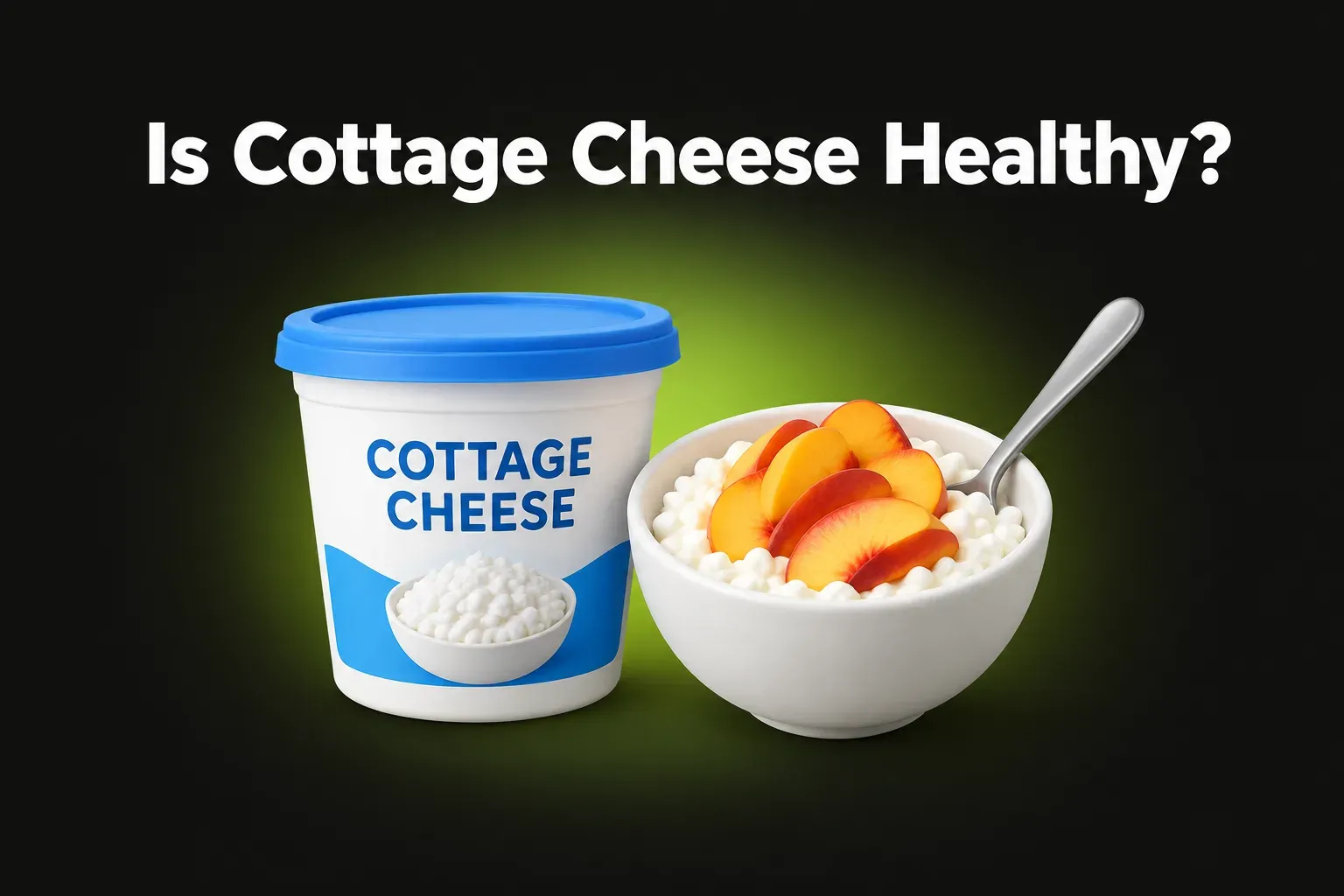
Cottage cheese went from “diet food” to TikTok star. People now blend it into ice cream and bake it into flatbread. But is cottage cheese healthy?
The short answer: yes, for most people. Half a cup has 10–15 g of protein for only 80–120 calories. It has little sugar and almost no carbs. The weak spots are salt and calcium. Half a cup has about 310–490 mg of sodium. And it has less calcium than you might think. Some brands also add gums, carrageenan or preservatives. Pick a plain tub with a short ingredient list, like milk, cream and salt.
Cottage cheese nutrition per 1/2 cup
Cottage cheese comes in four main types. The number tells you the milkfat. Here is half a cup (4 oz / 113 g) of each:
| Type (½ cup) | Calories | Protein | Fat | Saturated fat | Sodium | Calcium |
|---|---|---|---|---|---|---|
| 4% (regular) | 111 | 12.5 g | 4.9 g | 1.9 g | 356 mg | 94 mg |
| 2% (low fat) | 92 | 11.8 g | 2.6 g | 1.4 g | 348 mg | 125 mg |
| 1% (low fat) | 81 | 14.0 g | 1.2 g | 0.7 g | 459 mg | 69 mg |
| Nonfat (Kemps Fat Free) | 80 | 13 g | 0 g | 0 g | 490 mg | 130 mg |
Source: USDA FoodData Central – 4%, 2%, 1%, values per 100 g multiplied to 113 g. Nonfat: Kemps Fat Free label, checked November 2026.
What stands out:
- Protein: all four types have about 12–14 g. That’s as much as two eggs. Most of it is casein, a milk protein your body digests slowly.
- Fat: going from 4% to nonfat saves only about 30 calories per half cup. So pick the one you like. For a full breakdown by cup and by 100 g, see cottage cheese calories.
- Sugar: plain cottage cheese has only about 2–5 g. That’s lactose (milk’s natural sugar), not added sugar.
Is cottage cheese good for weight loss?
It can help, because protein keeps you full. In a French study, 30 healthy adults ate either cottage cheese or an omelet as a snack. Both had the same calories and 26 g of protein. People felt just as full after each one. They also ate the same amount at lunch (Marsset-Baglieri et al., Appetite, 2015).
So cottage cheese fills you up about as well as eggs. But it doesn’t burn fat by itself. A small US study gave 10 active women cottage cheese before bed. It did not change how many calories they burned the next morning. It didn’t change their hunger either (Leyh et al., British Journal of Nutrition, 2018). Find your daily target with our protein calculator.
A 2025 review sums it up well. Cottage cheese has a healthy image. But only a few small human studies have tested it (Farsi et al., Critical Reviews in Food Science and Nutrition, 2025). Most of its good name comes from its protein.
The downside: sodium
Salt is cottage cheese’s biggest weak spot. Half a cup has about 310–490 mg of sodium. That’s 13–21% of the 2,300 mg daily value on US labels. Two servings can add up to almost half a day’s worth.
Why does it matter? Too much salt raises blood pressure. A large review pooled 34 trials with about 3,200 people. Each trial lasted at least four weeks. When people ate about 4.4 g less salt a day, the top blood pressure number fell by about 4 points (He et al., BMJ, 2013).
What you can do:
- Compare labels. Breakstone’s has about 310 mg per half cup. Kemps and some nonfat tubs have 470–490 mg.
- Look for “no salt added.” The USDA lists a 1% no-salt-added cottage cheese with only about 15 mg of sodium per half cup (USDA).
- Add sweet toppings, not salty ones. Fruit and cinnamon add no sodium. Everything bagel seasoning and crackers add more.
Is cottage cheese high in calcium?
Not as high as you’d think. Cottage cheese is made by souring milk until it forms curds. The liquid part, called whey, drains away. A lot of milk’s calcium goes with it.
| Food (½ cup, 113 g) | Calcium | Protein |
|---|---|---|
| Plain low‑fat yogurt | 207 mg | 5.9 g |
| Greek yogurt, plain nonfat | 124 mg | 11.5 g |
| Cottage cheese, 4% | 94 mg | 12.5 g |
| Cottage cheese, 1% | 69 mg | 14.0 g |
Source: USDA FoodData Central – low-fat yogurt, Greek yogurt, 4% cottage cheese, 1% cottage cheese. Values per 100 g multiplied to 113 g.
Plain yogurt has about twice the calcium of 4% cottage cheese. Cottage cheese wins on protein. So if you count on dairy for strong bones, mix in yogurt or milk too. Our guide to the healthiest yogurt compares the brands. For Greek yogurt, see is Chobani healthy?
8 cottage cheese brands compared
Here are eight 4% cottage cheeses sold in US stores. Values are per half cup, from each label.
| Brand (4%) | Calories | Protein | Sodium | Saturated fat | What’s added besides milk, cream and salt |
|---|---|---|---|---|---|
| Daisy | 110 | 13 g | 370 mg | 3 g | Nothing |
| Good Culture Simply | 100 | 14 g | 380 mg | 3 g | Live and active cultures |
| Friendship Small Curd | 120 | 15 g | 370 mg | 3 g | Carbon dioxide, enzyme |
| Breakstone’s | 120 | 12 g | 310 mg | 3.5 g | Tapioca starch |
| Knudsen | about 110 | about 10 g | about 420 mg | 3 g | Whey, modified food starch, calcium phosphate, xanthan gum, guar gum, acetic acid, vitamin D3 |
| Hood Country Style | 120 | 13 g | 440 mg | 3 g | Whey protein concentrate, whey, natural flavor, xanthan gum, locust bean gum, guar gum, lactic acid, sorbic acid, carbon dioxide, enzymes |
| Great Value | 110 | 12 g | 410 mg | 3 g | Whey, maltodextrin, guar gum, citric acid, carrageenan, mono and diglycerides, locust bean gum, natural and artificial flavor, enzyme, potassium sorbate, carbon dioxide |
| Kemps | 110 | 12 g | 470 mg | 3 g | Whey protein concentrate, guar gum, mono and diglycerides, carob bean gum, natural flavor, potassium sorbate, carbon dioxide, carrageenan, polysorbate 80, enzymes |
Sources: brand sites for Daisy, Good Culture, Hood and Kemps; Open Food Facts product pages and label photos for Friendship, Breakstone’s, Knudsen and Great Value. Checked November 2026. Serving sizes are 110–117 g. Knudsen figures differ between sources, so they are marked “about”.
What stands out:
- Daisy, Good Culture and Friendship have the shortest labels. They are basically milk, cream and salt.
- Friendship has the most protein, at 15 g. Knudsen has the least, at about 10 g.
- Breakstone’s has the least sodium. Kemps has the most.
- Kemps and Great Value have the longest lists. Both contain carrageenan. Kemps also has polysorbate 80.
Gums, carrageenan and “cream dressing”
Cottage cheese has two parts: the curds and a creamy sauce mixed in with them. Labels sometimes call this sauce the “cream dressing.” Some brands use only cream and salt. Others thicken it with gums so it stays creamy and doesn’t turn watery.
Here is what the most common additives do – and what research says.
Guar gum, xanthan gum and locust bean gum (also called carob bean gum) thicken the dressing. They act a lot like fiber in your gut. In small amounts, they seem fairly gentle. But a big French study raised a question. It followed about 104,000 adults for almost 7 years. People who ate more guar gum and xanthan gum had a slightly higher risk of type 2 diabetes. For guar gum, the risk was about 11% higher for every extra 500 mg a day (Salame et al., The Lancet Diabetes & Endocrinology, 2024). This kind of study shows a link, not proof.
Carrageenan is a thickener made from red seaweed. It has more warning signs:
- In mice, a small dose in drinking water (10 mg per liter) raised blood sugar and made insulin work worse (Bhattacharyya et al., Diabetologia, 2012).
- In people, a 2024 trial gave 20 young men 250 mg of carrageenan twice a day for 2 weeks. Overall, there was no change. But in the men who were overweight, insulin worked worse. Their blood tests also showed more inflammation (the body’s alarm response) (Wagner et al., BMC Medicine, 2024).
- In the same French study, people who ate more carrageenan had a higher risk of type 2 diabetes. It was about 3% higher for every extra 100 mg a day.
Polysorbate 80 is an emulsifier (it helps fat and water mix). In one study, mice got up to 1% of it in their drinking water. Gut bacteria pushed into the mucus layer that normally protects the gut wall. The mice got mild gut inflammation, gained fat and had trouble controlling blood sugar (Chassaing et al., Nature, 2015).
Why do mouse studies matter? Mice share most of our genes and body processes. And testing a possibly harmful additive on people for years would put their health at risk. Proof in humans is still missing for most of these effects. But several labs see the same warning signs. So it makes sense to limit carrageenan and polysorbate 80 as a precaution. That’s easy here, because many cottage cheeses have neither.
Potassium sorbate and sorbic acid are preservatives that stop mold. They are among the better-studied additives. In one lab test, scientists put potassium sorbate on human white blood cells in a dish. At 125–1,000 micrograms per milliliter, it damaged the cells’ DNA (Mamur et al., Toxicology in Vitro, 2010). But cells in a dish are not the same as eating it. Proof of harm in people is missing.
Is cottage cheese ultra-processed?
A plain tub of milk, cream and salt is a minimally processed food. A tub with carrageenan, emulsifiers and flavors counts as ultra-processed. Same food, two very different labels.
Live cultures: does cottage cheese have probiotics?
All cottage cheese starts with cultures (good bacteria) that sour the milk. Then the curds are cooked, and heat can kill many of these bacteria. So many brands don’t promise live bacteria in the tub.
- Daisy says its cottage cheese is made “with live and active cultures.” The tub carries a “Contains Live & Active Cultures” seal.
- Good Culture lists “live and active cultures (Lactococcus ssp., Lactobacillus ssp.)” in its ingredients.
The other six brands in our table don’t list live cultures on the labels we checked. If probiotics matter to you, look for that line. Yogurt and kefir are still the more reliable sources.
The TikTok trend: cottage cheese ice cream and flatbread
In 2023 and 2024, cottage cheese became a social media hit. A cottage cheese ice cream recipe went viral in spring 2023. Flatbreads, pancakes and pudding followed. The #cottagecheese hashtag passed half a billion views on TikTok in a year. US sales rose 13.5% to $1.33 billion in the year to May 2024, says the market research firm Circana (Modern Retail, 2024).
Are these recipes healthy? Mostly, yes:
- Cottage cheese ice cream is blended cottage cheese with fruit, honey or maple syrup, then frozen. It has far more protein than regular ice cream. Just measure the sweetener.
- Cottage cheese flatbread is cottage cheese and eggs baked into a thin wrap. It’s high in protein and low in carbs. It also keeps all the salt of the cottage cheese.
- Whipped cottage cheese is a lighter swap for cream cheese on bagels and toast.
For more snack ideas, see our list of high protein snacks.
How to pick a healthy cottage cheese
- Read the ingredients. Look for milk, cream, salt and cultures. Skip tubs with carrageenan or polysorbate 80.
- Compare sodium. Aim for 400 mg or less per half cup, or try a no-salt-added version.
- Choose any fat level you like. 4% often has the shortest label. Nonfat saves calories but may have more thickeners.
- Buy plain. Add fresh peaches, berries or pineapple yourself. Ready-made fruit cups can have added sugar.
- Want probiotics? Look for “live and active cultures” on the label.
Find the best cottage cheese in the store. With NutriSmart, you photograph the label or scan the barcode. The app lists the sweeteners, preservatives and colors, explains the risks of each one and gives the product a health score out of 100. It also tells you right away if a cottage cheese is ultra-processed, and which ingredients make it so. Set an alert for carrageenan, and the app warns you whenever a tub you scan contains it.Get the app free
The bottom line
Cottage cheese is a healthy, high-protein food for most people. Half a cup gives you 10–15 g of protein for about 80–120 calories. Its weak spots are sodium and calcium. Some brands also add gums, carrageenan or polysorbate 80. Choose a plain tub with a short label, like Daisy, Good Culture or Friendship. Compare the salt, and add your own fruit.
FAQ
Is cottage cheese healthy?
Yes, for most people. Half a cup has 10–15 g of protein for about 80–120 calories. The downsides are salt – about 310–490 mg per half cup – and, in some brands, gums and preservatives.
Is cottage cheese good for weight loss?
It can help. It gives a lot of protein for few calories, and protein keeps you full. Choose plain cottage cheese and add your own fruit instead of buying fruit cups with added sugar.
Is 4% or nonfat cottage cheese better?
Both are fine. Nonfat saves about 30 calories per half cup, but it often has more gums and thickeners to make it creamy. 4% usually has a shorter ingredient list.
Does cottage cheese have probiotics?
Only some brands. Daisy and Good Culture say their cottage cheese contains live and active cultures. Many other brands make no such claim, so check the label.
Is cottage cheese high in sodium?
Yes. Half a cup has about 310–490 mg of sodium, or 13–21% of the daily value. If you watch your salt, compare brands or look for a no-salt-added version.
Is cottage cheese a good source of calcium?
Not really. Half a cup has about 70–130 mg of calcium. The same amount of plain low-fat yogurt has about 200 mg. Much of milk's calcium drains away with the whey when cottage cheese is made.