Is Miso Soup Healthy? Sodium, Benefits and 8 Instant Soups
Is miso soup healthy? Calories and sodium per cup, what Japanese studies show on blood pressure and cancer, and 8 instant miso soups compared.
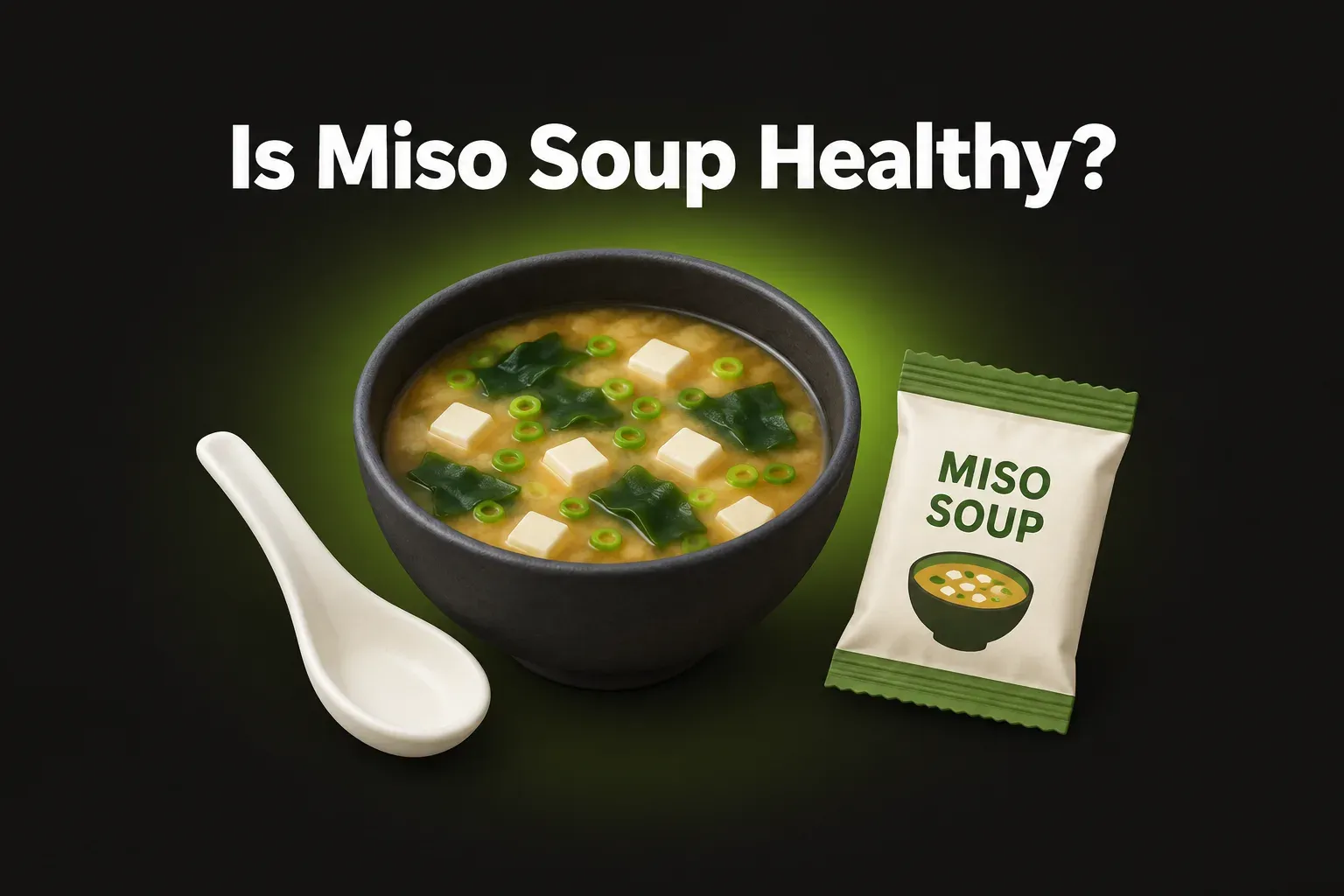
Miso soup is the small, cloudy bowl that comes before sushi. It’s warm, light and full of savory flavor. But it’s made from a salty paste.
The short answer: yes, miso soup is a healthy choice for most people, in normal amounts. A cup has only about 30–60 calories, a little protein and some tofu and seaweed. The big catch is sodium. One bowl often has 700–1,100 mg – up to half of the daily value. Studies in Japan show that people who eat miso soup often don’t have higher blood pressure. But 3 or more bowls a day were linked to more stomach cancer. Have one bowl, choose lower-sodium options and read the label on instant packets.
Miso soup nutrition per cup
Here is what you get in a typical serving.
| Serving | Calories | Protein | Fat | Carbs | Sodium |
|---|---|---|---|---|---|
| Miso soup, 1 cup (USDA) | 59 | 5.4 g | 2.1 g | 5.6 g | 1,144 mg |
| Benihana miso soup, 1 bowl (6.45 oz) | 30 | 2 g | 1 g | 4 g | 950 mg |
| Miso paste only, 1 tbsp (17 g) | 34 | 2.2 g | 1.0 g | 4.3 g | 634 mg |
Sources: USDA FoodData Central – soup, miso or tofu and miso, values per 100 g multiplied to 1 cup (245 g) and 1 tbsp (17 g); Benihana nutrition guide, January 2025.
What stands out:
- Calories are very low. Even a full cup has under 60 calories.
- Sodium is high. The USDA cup has about half of the 2,300 mg daily value.
- Protein is small. Tofu adds a bit. A cup with more tofu gives more.
See how it compares with rolls and sashimi in our guide to whether sushi is healthy.
What’s in miso soup
Miso is a thick paste made from soybeans, salt and koji. Koji is rice or barley grown with a friendly mold called Aspergillus oryzae. The mix sits for weeks to years and ferments (friendly microbes slowly break it down). That gives miso its deep, savory taste.
White miso (shiro) ferments for a short time and tastes mild. Red miso (aka) ferments longer and tastes stronger. Yellow miso is in between.
The soup is simple. Cooks stir miso into dashi, a broth often made from kelp and dried bonito (a fish). Then they add tofu, wakame seaweed and green onion. So most miso soup is not vegan, because of the fish broth. Tofu brings protein and some calcium – read more in is tofu healthy?
The salt problem
Miso can’t be made without a lot of salt. Salt keeps bad microbes out while it ferments. One tablespoon of plain miso has about 634 mg of sodium, says the USDA. Some brands have more than 800 mg.
The daily value for sodium on US labels is 2,300 mg. So one bowl can use up a third to half of it.
In Japan, miso soup is one of the main sources of salt. A study of 8,821 adults in Sado City checked salt in their urine. People who ate miso soup more often took in more salt each day (Wakasugi et al., Internal Medicine, 2015).
Does miso soup raise blood pressure?
Here is the surprise. Too much salt raises blood pressure. But miso soup doesn’t seem to act like plain salt.
- Study of 527 adults: Japanese adults aged 50 to 81 said how often they ate miso soup. How often they ate it was not linked to their blood pressure. People who ate it most had a slightly lower heart rate (Ito et al., Internal Medicine, 2017).
- Five-year study: about 4,200 Japanese adults had normal blood pressure at the start. Those who ate the most fermented soy (miso and natto) were 28% less likely to get high blood pressure (Nozue et al., Journal of Nutrition, 2017).
- Rat study: scientists used rats that are bred to get high blood pressure from salt. For 12 weeks, one group ate food with 2.3% salt. Another group ate food with the same 2.3% salt, but from miso. Plain salt raised blood pressure. Miso did not (Watanabe et al., Hypertension Research, 2006).
Why do rat studies matter? Rats share most of our genes and body processes. And feeding people high salt for months to see what happens would put their health at risk. A review of this research says compounds in miso may calm the nerves that raise blood pressure (Ito, Environmental Health and Preventive Medicine, 2020).
But proof in people is still missing. The human studies above show a link, not cause. So if you have high blood pressure, still count the sodium in miso soup.
Miso soup and stomach cancer
Salt is a known risk for stomach cancer. And Japan and Korea have high rates of it.
- Large Japanese study: about 40,700 adults aged 40 to 79 were followed for about 14 years. Some ate 3 or more bowls of miso soup a day. Their risk of stomach cancer was about 60% higher than in people who ate less (Umesawa et al., Journal of Epidemiology, 2016).
- Salt study: about 39,000 Japanese adults were followed for about 11 years. Men who ate the most salt got stomach cancer more often. Very salty foods, like salted fish eggs, were strongly linked to it in both men and women (Tsugane et al., British Journal of Cancer, 2004).
- Review of studies from Japan and Korea: it pooled 20 studies on fermented soy and 17 on non-fermented soy. Eating a lot of fermented soy foods like miso was linked to a 22% higher risk of stomach cancer. Non-fermented soy, like tofu, was linked to a 36% lower risk (Kim et al., Cancer Science, 2011).
The likely problem is the salt, not the soybeans. One bowl now and then is a very different habit from 3 a day.
Other possible benefits
Some studies point to good news too:
- Longer life: a Japanese study followed about 93,000 adults for almost 15 years. Those who ate the most fermented soy (natto and miso) had about a 10% lower risk of dying during the study. The authors warn that other habits may explain part of this (Katagiri et al., BMJ, 2020).
- Breast cancer: about 21,900 Japanese women were followed for about 10 years. Women who ate miso soup often had a lower risk of breast cancer (Yamamoto et al., Journal of the National Cancer Institute, 2003).
These are links, not proof.
Does miso soup have probiotics?
Probiotics are live microbes that may help your gut. Miso paste is fermented, so it can contain them. But two things can kill them:
- Pasteurizing. Some misos are heated so they keep longer. Look for “unpasteurized” or “live” on the tub, and buy it from the fridge.
- Boiling. Hot soup kills most live microbes. That’s why many cooks turn off the heat first, then stir in the miso.
Instant packets are dried or heated, so don’t count on them for live cultures. If live cultures are your goal, raw sauerkraut and kefir are better bets.
Instant miso soup: 8 products compared
Here are 8 quick packets, cubes and concentrates sold in the US, per serving.
| Product | Serving | Calories | Protein | Sodium | Flavor boosters |
|---|---|---|---|---|---|
| Kikkoman Instant Tofu Miso Soup | 1 packet (10 g) | 35 | 3 g | 760 mg | MSG, hydrolyzed soy protein, disodium inosinate and guanylate |
| Kikkoman Instant Shiro Miso Soup | 1 packet (10 g) | 35 | 2 g | 770 mg | MSG, hydrolyzed soy protein, disodium inosinate and guanylate |
| Kikkoman Aka (Red) Miso Soup | 1 packet (10 g) | 30 | 2 g | 870 mg | MSG, yeast extract, hydrolyzed protein, disodium inosinate and guanylate |
| Marukome Instant Miso Soup Tofu & Wakame | 1 packet (19 g) | 30 | 2 g | 730 mg | Yeast extract, autolyzed sardine protein |
| Shinsyu-ichi (Miyasaka) Instant Miso Soup | 1 packet (19 g) | about 24 | about 2 g | about 760 mg | MSG, disodium inosinate |
| Edward & Sons Organic Miso-Cup with Tofu | 1 packet (9 g) | 30 | 2 g | 710 mg | None |
| Tsubi Yellow Miso with Garden Veggies | 1 packet (10.4 g) | 35 | 2 g | 480 mg | Yeast extract |
| Marukome Miso Broth Concentrate | 1 tbsp (15 g) | 20 | 1 g | 660 mg | Yeast extract |
Sources: labels on Open Food Facts for Kikkoman Tofu, Kikkoman Shiro, Kikkoman Aka, Marukome Tofu & Wakame, Shinsyu-ichi, Edward & Sons and Marukome Broth Concentrate; Tsubi label from the Tsubi shop, checked November 2026. Recipes change – always check the packet.
What to notice:
- Calories are tiny in every one: 20 to 35.
- Sodium is the real difference. Tsubi has 480 mg. Kikkoman Aka has 870 mg.
- Only Edward & Sons skips added flavor boosters. Its list is miso, tofu, onion, green onion, parsley and wakame.
- Fish: the Kikkoman, Marukome and Shinsyu-ichi products list bonito or other fish. Edward & Sons and Tsubi are plant-based. Kikkoman Shiro and Aka also contain wheat gluten. All contain soy.
MSG, yeast extract and other flavor boosters
Many packets add MSG (monosodium glutamate). It gives a strong savory taste. Regulators like the FDA call it safe in normal amounts. But independent research is more mixed.
- Human trial: 130 people believed they reacted to MSG. They took 5 g of MSG without food on one day and a fake pill on another. Large doses caused more mild symptoms than the fake pill. But the reactions didn’t repeat when people were tested again (Geha et al., Journal of Allergy and Clinical Immunology, 2000).
- Animal study: newborn mice got large MSG shots under the skin. They had brain damage, and later obesity (Olney, Science, 1969). A 2023 review of animal studies found nerve damage and memory problems in mice given MSG (Ankul et al., Frontiers in Pharmacology, 2023).
Why do mouse studies matter? Mice share most of our genes and body processes. And giving people large doses for years to look for harm would put their health at risk. Shots are not the same as eating it, though. Proof of harm from MSG in food is still missing in people. The labels also don’t say how much MSG a packet has. Still, several labs have seen the same signals. So if you eat instant soup often, it’s reasonable to limit MSG as a precaution.
Yeast extract works in a similar way. It is rich in free glutamate, the same savory part as MSG. So a packet can say “no added MSG” and still taste like it. Disodium inosinate and guanylate boost the effect even more. Together, these make many packets ultra-processed.
Miso paste: what the tubs say
Making soup from paste lets you control how much goes in. Here is what a few tubs list.
| Miso paste | Serving | Calories | Protein | Sodium | Ingredients |
|---|---|---|---|---|---|
| Miso (USDA average) | 1 tbsp (17 g) | 34 | 2.2 g | 634 mg | – |
| Hikari Organic White Miso | 1 tbsp (18 g) | 35 | 2 g | 820 mg | Water, organic soybeans, organic rice, salt, yeast, koji culture |
| Hikari Organic Red Miso | 1 tbsp (18 g) | about 37 | 1.5 g | 825 mg | Water, organic soybeans, organic rice, salt, yeast, koji culture |
| Cold Mountain Red Miso | 1 tsp (7 g) | 10 | 1 g | 340 mg | Filtered water, organic whole soybeans, cultured rice, sea salt |
Sources: USDA FoodData Central; labels on Open Food Facts for Hikari White, Hikari Red and Cold Mountain, checked November 2026.
Plain miso paste has a short, simple list. Note the serving sizes. Cold Mountain lists a teaspoon. A tablespoon of it would be about 1,000 mg of sodium. The USDA recipe uses about 12 g of miso per cup – a bit under a tablespoon.
How to make miso soup lower in sodium
- Use less paste. Start with 2 teaspoons per cup instead of a tablespoon. Taste, then add more only if you need it.
- Try reduced-salt miso. A 6-week Japanese trial split 64 adults into two groups. One group used miso with about 20% less salt and soy sauce with about 25% less salt. The other group used regular versions. Overall, blood pressure didn’t change. But in people aged 40 and up, the lower blood pressure number dropped by about 6 mmHg (Nakamura et al., Circulation Journal, 2003).
- Make your own broth. Kelp and dried mushrooms give flavor without added salt or flavor boosters.
- Load up the bowl. Add more tofu, spinach, mushrooms or seaweed. You get more food and less broth per spoon.
- Have one bowl. Skip the refill, and keep the rest of the meal less salty – go easy on soy sauce.
Check your instant miso soup in seconds. With NutriSmart, you photograph the label or scan the barcode. The app lists the sweeteners, preservatives and colors, explains the risks of each one and gives the product a health score out of 100. It also tells you right away if an instant miso soup is ultra-processed, and which ingredients make it so. Set an alert for MSG, and the app warns you whenever a packet you scan contains it.Get the app free
The bottom line
Miso soup is a healthy, low-calorie food for most people, with about 30–60 calories per cup. Japanese studies don’t link it to higher blood pressure, and fermented soy is tied to a longer life. The weak spot is salt. One bowl has 700–1,100 mg of sodium. And 3 or more bowls a day were linked to stomach cancer. Have one bowl, use less paste and stir it in off the heat. With instant packets, pick the lowest sodium and the shortest list.
FAQ
Is miso soup healthy?
Mostly, yes. A cup has only about 30–60 calories and a little protein. The catch is salt: one bowl often has 700–1,100 mg of sodium, so one bowl a day fits better than three.
How much sodium is in miso soup?
A bowl at Benihana has 950 mg, and a cup in the USDA database has about 1,140 mg. Instant packets have about 480–870 mg. The daily value on US labels is 2,300 mg.
Does miso soup raise blood pressure?
In Japanese studies, people who ate miso soup often did not have higher blood pressure. Rat studies suggest miso raises it less than the same amount of plain salt. If you have high blood pressure, still count its sodium.
Does miso soup have probiotics?
Miso paste can have live microbes if it isn't pasteurized. But soup that boils kills most of them. Stir the miso in after you turn off the heat to keep more alive.
Is instant miso soup healthy?
It's low in calories, but most packets have 700 mg of sodium or more. Many also add MSG, yeast extract or other flavor enhancers. A few brands have short lists with just miso, tofu and vegetables.
Can you eat miso soup every day?
Many people in Japan do. One bowl a day is fine for most people if the rest of your day isn't salty. A large Japanese study linked 3 or more bowls a day to a higher risk of stomach cancer.