Is White Rice Healthy? Carbs, GI, Arsenic and Portions
Is white rice healthy? Calories, carbs and GI vs brown, jasmine and basmati, the diabetes link, arsenic, cooled rice, and 8 rice packets compared.
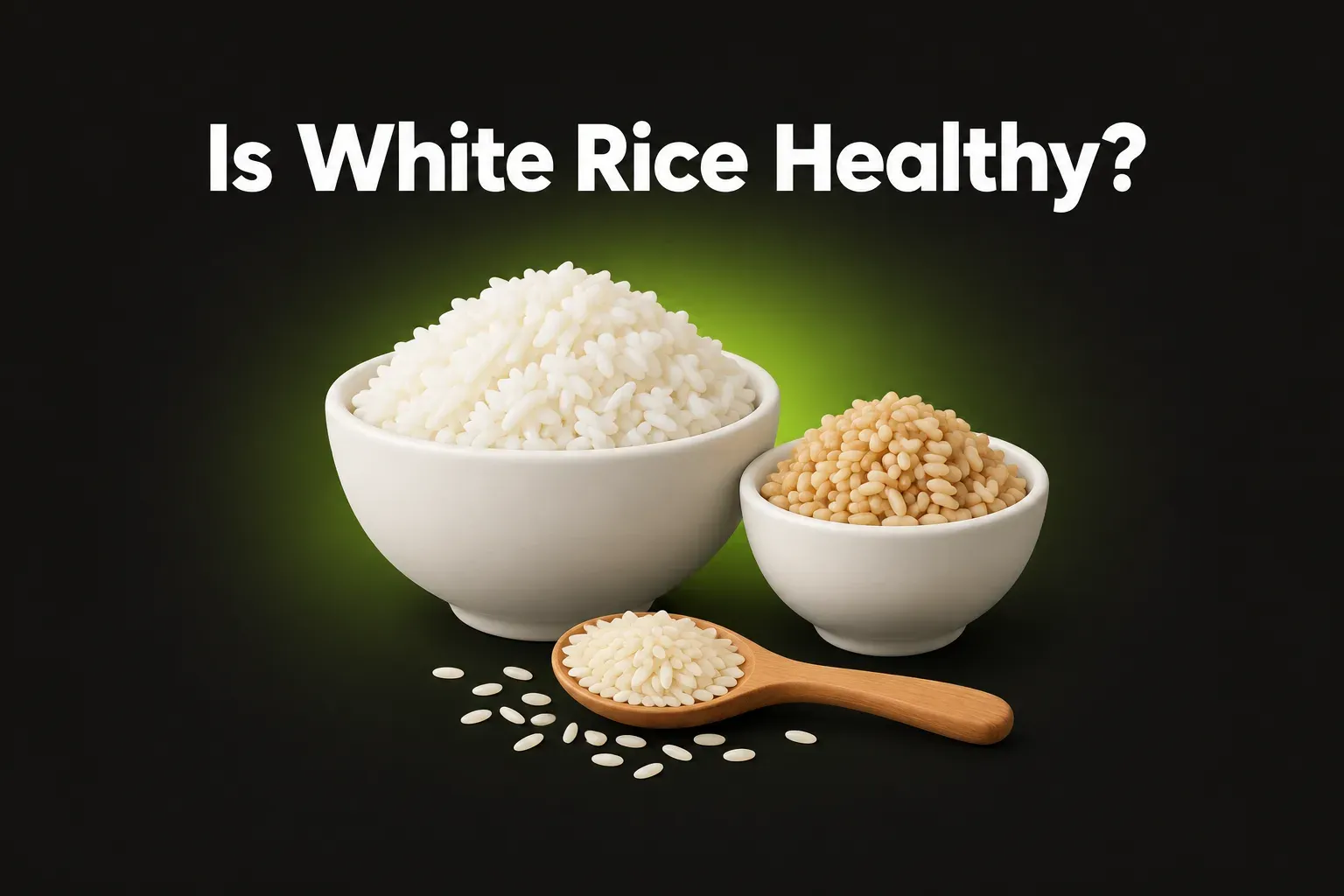
White rice is on the table for billions of people every day. But it has a bad reputation as “empty carbs.” So is it really a problem?
The short answer: white rice is fine in normal portions for most people. A cup of cooked long-grain white rice has about 205 calories, 45 g of carbs and less than 1 g of fiber. It raises blood sugar fast. Large studies link eating a lot of it every day to a higher risk of type 2 diabetes. Keep rice to about a quarter of your plate. Choose basmati, parboiled or brown rice more often. Cook it in extra water to cut arsenic. And watch the sodium in flavored rice packets.
White vs brown vs parboiled rice: nutrition per cup
Here is what one cup of cooked rice gives you, based on USDA data.
| Rice (1 cup cooked) | Calories | Carbs | Fiber | Protein | Magnesium |
|---|---|---|---|---|---|
| White, long-grain (158 g) | 205 | 44.6 g | 0.6 g | 4.3 g | 19 mg |
| Brown, long-grain (202 g) | 248 | 51.7 g | 3.2 g | 5.5 g | 79 mg |
| Parboiled white (158 g) | 194 | 41.1 g | 1.4 g | 4.6 g | 14 mg |
| Instant white (165 g) | 205 | 44.2 g | 1.0 g | 3.6 g | 8 mg |
| Wild rice (164 g) | 166 | 34.9 g | 3.0 g | 6.5 g | 52 mg |
Source: USDA FoodData Central – white long-grain, brown long-grain, parboiled, instant, wild rice. Values per 100 g, multiplied to one cup and rounded.
What stands out:
- Calories are close. A cup of brown rice has more calories only because a cup of it weighs more. Per 100 g, white rice has 130 and brown rice 123. See all the numbers in calories in rice.
- Fiber is the big gap. Brown rice keeps the bran, the outer layer of the grain. That’s where the fiber, magnesium and many vitamins are. White rice loses the bran when it’s polished.
- Much white rice is “enriched.” In the US, many brands add iron, folate and some B vitamins back after milling. Fiber and magnesium are not added back. Check the label – Minute Instant White Rice, for example, lists 0 mg of iron.
- Parboiled rice is steamed in its husk before milling. That pushes some nutrients into the grain. It has a bit more fiber than regular white rice.
- Jasmine and basmati are both long-grain white rices. USDA doesn’t list them on their own. Their calories are about the same as regular long-grain white rice.
Need more fiber? See the best high-fiber foods.
The glycemic index of rice
The glycemic index (GI) shows how fast a food raises your blood sugar. Pure glucose is 100. A GI of 55 or less is low, and 70 or more is high.
Rice GI varies a lot. It depends on the type of rice, where it’s grown and how it’s cooked. The international GI tables give white rice an average of 73 and brown rice 68 (Atkinson et al., Diabetes Care, 2008). The newest tables say rice comes in high, medium and low GI versions (Atkinson et al., American Journal of Clinical Nutrition, 2021). Here is how the main types compare in the same team’s online database.
| Rice (cooked) | Typical GI | Range in tests | Rating |
|---|---|---|---|
| Jasmine | about 85 | 68–116 | High |
| White rice (average of all kinds) | 73 | very wide | High |
| Brown | about 65 | 48–88 | Medium |
| Basmati, white | about 60 | 50–67 | Medium |
| Parboiled, white | about 57 | 47–75 | Medium |
Source: University of Sydney GI database, checked November 2026 – middle value and range of the main-list tests of plain rice (not mixed dishes) in healthy adults. Average for all white rice: Atkinson et al., 2008. Low GI = 55 or less, medium = 56–69, high = 70 or more.
Jasmine rice stands out. In a US study, 12 healthy adults ate four brands of jasmine rice. Their GI was 96 to 116. For some brands, that’s higher than pure glucose. Rice grown in the US and in Thailand acted the same (Truong et al., International Journal of Food Sciences and Nutrition, 2014).
Why the difference? Rice has two kinds of starch. One kind (amylose) digests slowly. The other (amylopectin) breaks down fast. Basmati and other long-grain rices have more of the slow kind. Soft, sticky rices like jasmine and short-grain rice have more of the fast kind. Parboiling also changes the starch, so it breaks down more slowly. Plain long-grain white rice has only a few tests, and most came in at about 45 to 60. Learn more in our guide to low glycemic index foods.
White rice and type 2 diabetes
This is the main health worry about white rice.
A Harvard review (2012). Researchers pooled 7 groups of people. That was about 352,000 adults followed for 4 to 22 years. In China and Japan, people ate 3–4 servings of white rice a day. Those who ate the most had a 55% higher risk of type 2 diabetes. In Western countries such as the US, people ate only 1–2 servings a week. There, the link was small and not clear. Overall, each extra daily serving was linked to an 11% higher risk (Hu et al., BMJ, 2012).
The PURE study (2020). It followed about 132,000 adults in 21 countries for about 9.5 years. Some people ate 3 cups (450 g) or more of cooked white rice a day. They had a 20% higher risk than people who ate less than 1 cup. The link was strongest in South Asia (61% higher risk). In China, there was no clear link (Bhavadharini et al., Diabetes Care, 2020).
US nurses and health workers (2010). This study followed about 197,000 Americans. Eating white rice 5 or more times a week was linked to a 17% higher risk. Eating brown rice 2 or more times a week was linked to an 11% lower risk. Swapping just 50 g of white rice a day (about 1/3 cup) for brown rice was linked to a 16% lower risk (Sun et al., Archives of Internal Medicine, 2010).
What this means: these studies show a link, not proof. Big rice eaters may differ in other ways too. But the risk shows up in many countries, and with large amounts every day. A cup a few times a week is a very different habit. If you have diabetes, see our diabetic meal plan.
Arsenic in rice
Rice takes up more arsenic from soil and water than most crops. Arsenic is a natural element. Its inorganic form can cause cancer with long-term exposure.
- Brown rice has more. In 2014, Consumer Reports looked at test results for 697 rice samples. Brown rice had 80% more inorganic arsenic on average than white rice of the same type (Consumer Reports, 2014, via Food Safety News). Arsenic builds up in the bran.
- Where it’s grown matters. White basmati from California, India and Pakistan, and US-grown sushi rice, had about half the arsenic of most other rice. Rice from Arkansas, Louisiana and Texas had the most.
- Organic doesn’t help. Organic rice takes up arsenic the same way.
How to cut arsenic at home:
- Cook rice like pasta. Use 6 to 10 cups of water for each cup of rice, then drain the extra. The FDA says this removes 40–60% of inorganic arsenic. The catch: it also removes half or more of the added iron, folate and B vitamins in enriched rice (FDA).
- Or boil, drain, then finish. In a UK study, rice was first boiled for a short time, and that water was poured off. Then it was cooked in fresh water until the rice soaked it all up. This removed 73% of inorganic arsenic from white rice and 54% from brown rice. Mineral losses were the same as or smaller than with the pasta method (Menon et al., Science of the Total Environment, 2021).
- Rinsing helps only a little. In one study, rinsing removed about 10% of the arsenic from basmati rice (Raab et al., Journal of Environmental Monitoring, 2009). The FDA says rinsing has a minimal effect and washes off added vitamins.
- Mix up your grains. Quinoa, barley, bulgur, millet and grits have much less arsenic. This matters most for babies and young kids. The FDA and the American Academy of Pediatrics say rice cereal shouldn’t be a baby’s only cereal.
Cooled rice and resistant starch
When cooked rice cools, some of its starch changes shape. It becomes resistant starch, a starch that acts more like fiber. Your body digests it slowly.
In a study from Indonesia, cooked white rice was cooled in the fridge for 24 hours and then reheated. It had 1.65 g of resistant starch per 100 g, vs 0.64 g in fresh rice. Then 15 healthy adults ate both kinds. The reheated rice raised their blood sugar about 18% less (Sonia et al., Asia Pacific Journal of Clinical Nutrition, 2015).
So cooking rice ahead can help a little. But be safe. Rice can carry Bacillus cereus, a germ that makes toxins when rice sits out too long. Put cooked rice in the fridge within 2 hours (1 hour on a day above 90°F / 32°C). Eat it within 3–4 days, and reheat it to 165°F (74°C). Reheating may not destroy toxins that have already formed, so throw out rice that sat out too long (Utah State University Extension).
How much rice should you eat?
Most people eat more rice than they think. It’s easy to pile 2 cups on a plate. That’s about 410 calories of plain white rice before anything else.
Use the plate method from the American Diabetes Association. Take a 9-inch plate. Fill half with non-starchy vegetables. Fill a quarter with lean protein. Fill the last quarter with carb foods like rice (Diabetes Food Hub).
That’s a modest scoop of rice, not a mound. A few tips:
- Eat rice with protein, vegetables and a little fat. They slow down how fast the carbs reach your blood. Rice with chicken and broccoli is very different from a big bowl of plain rice.
- Stretch the rice. Mix in beans, peas or chopped vegetables.
- Check your daily needs with our calorie calculator.
Sushi is mostly rice too – see is sushi healthy? And a bowl of pho is built on rice noodles. At takeout spots, see how the rice sides compare in is Panda Express healthy?
Instant rice and flavored rice packets
Plain instant rice is just rice that was cooked and dried. It’s fine to eat. The problem is the flavored cups and pouches. Here are 8 products sold in the US.
| Product | Serving | Calories | Carbs | Sodium |
|---|---|---|---|---|
| Minute Instant White Rice | 1/2 cup dry (makes 1 cup) | 170 | 38 g | 0 mg |
| Minute Instant Brown Rice | 1/2 cup dry (makes 1 cup) | 180 | 39 g | 0 mg |
| Minute Ready to Serve White Rice | 1 cup (125 g) | 200 | 39 g | 150 mg |
| Ben’s Original Ready Rice Jasmine | 1 cup (143 g) | 250 | 51 g | 0 mg |
| Ben’s Original Ready Rice Spanish Style | 1 cup (144 g) | 200 | 41 g | 300 mg |
| Ben’s Original Ready Rice Roasted Chicken | 1 cup (144 g) | 220 | 44 g | 340 mg |
| Minute Ready to Serve Yellow Rice | 1 cup (125 g) | 230 | 47 g | 630 mg |
| Minute Ready to Serve Chicken & Herb | 1 cup (125 g) | 230 | 44 g | 650 mg |
Sources: nutrition labels on the brand sites – Minute Instant White, Instant Brown, Ready to Serve White, Yellow and Chicken & Herb; Ben’s Original Jasmine, Spanish Style and Roasted Chicken, checked November 2026. Recipes change – always check the package.
What to notice:
- Plain rice has little or no sodium. Minute Instant White and Brown list just one ingredient: precooked rice.
- Flavored cups can have over 600 mg of sodium per cup. The daily value on US labels is 2,300 mg. So one cup of Minute Chicken & Herb gives you 28% of it.
- The whole pouch counts. A Ben’s Original pouch holds about 1.7 cups. The whole Spanish Style pouch has 520 mg of sodium, and Roasted Chicken has 590 mg.
- Seasonings add extras. Minute Chicken & Herb lists maltodextrin and yeast extract in its seasoning. Yeast extract adds a savory taste, much like MSG.
Buy plain rice and season it yourself with herbs, garlic, lime or low-sodium soy sauce.
Who should be careful with white rice
White rice has upsides. It’s gluten-free and easy on the stomach. But go easy on big portions if you:
- Have prediabetes or diabetes. Pick basmati, parboiled or brown rice, with protein and vegetables.
- Are trying to lose weight. Rice is easy to overeat, so measure it.
- Feed babies or young kids. Rotate oats, barley and other grains to limit arsenic.
Track your rice and the rest of your meal. With NutriSmart, you just photograph what you eat. The app counts the calories, protein, carbs and fat on your plate. Then it shows how much you have left for your daily target, so you can see if that second scoop of rice fits.Get the app free
The bottom line
White rice is not a health food, but it’s not poison either. A cup has about 205 calories, 45 g of carbs and almost no fiber, and it raises blood sugar fast. Large studies link eating a lot of it every day to type 2 diabetes. Keep it to a quarter of your plate and eat it with protein and vegetables. Choose basmati, parboiled or brown rice more often. Cook it in extra water to cut arsenic, try cooled and reheated rice, and skip the salty flavored packets.
FAQ
Is white rice healthy?
White rice is a fine part of a healthy diet in normal portions. A cup has about 205 calories, 45 g of carbs and almost no fiber. Big portions every day are linked to a higher risk of type 2 diabetes, so keep it to about a quarter of your plate.
Is brown rice healthier than white rice?
A little. Brown rice has about 3 g of fiber per cup and four times more magnesium. Swapping some white rice for brown was linked to a lower diabetes risk. But brown rice also has more arsenic, so variety matters.
Which rice has the lowest glycemic index?
Basmati and parboiled rice usually have a GI of about 60. White rice as a whole averages about 73, and jasmine rice is often 85 or higher. Cooling cooked rice and eating it with protein and vegetables also helps.
Should I worry about arsenic in rice?
Most adults don't need to stop eating rice. To lower arsenic, cook it like pasta in lots of water and drain it. White basmati from California, India or Pakistan tends to have less. Vary your grains, especially for babies and young kids.
Is reheated rice healthier?
Rice that is cooled in the fridge and then reheated has more resistant starch. In a small study, it raised blood sugar less than fresh rice. Put leftovers in the fridge within 2 hours and eat them within 3–4 days.
Is instant rice bad for you?
Plain instant rice is fine – Minute Instant White Rice is just precooked rice with 0 mg of sodium. The flavored cups and pouches are the problem. Some have over 600 mg of sodium per cup.