Healthiest Butter: 8 Butters and Spreads Compared
What is the healthiest butter? Regular, grass-fed, ghee, light, olive oil blends and plant butters compared by saturated fat, oils and additives.
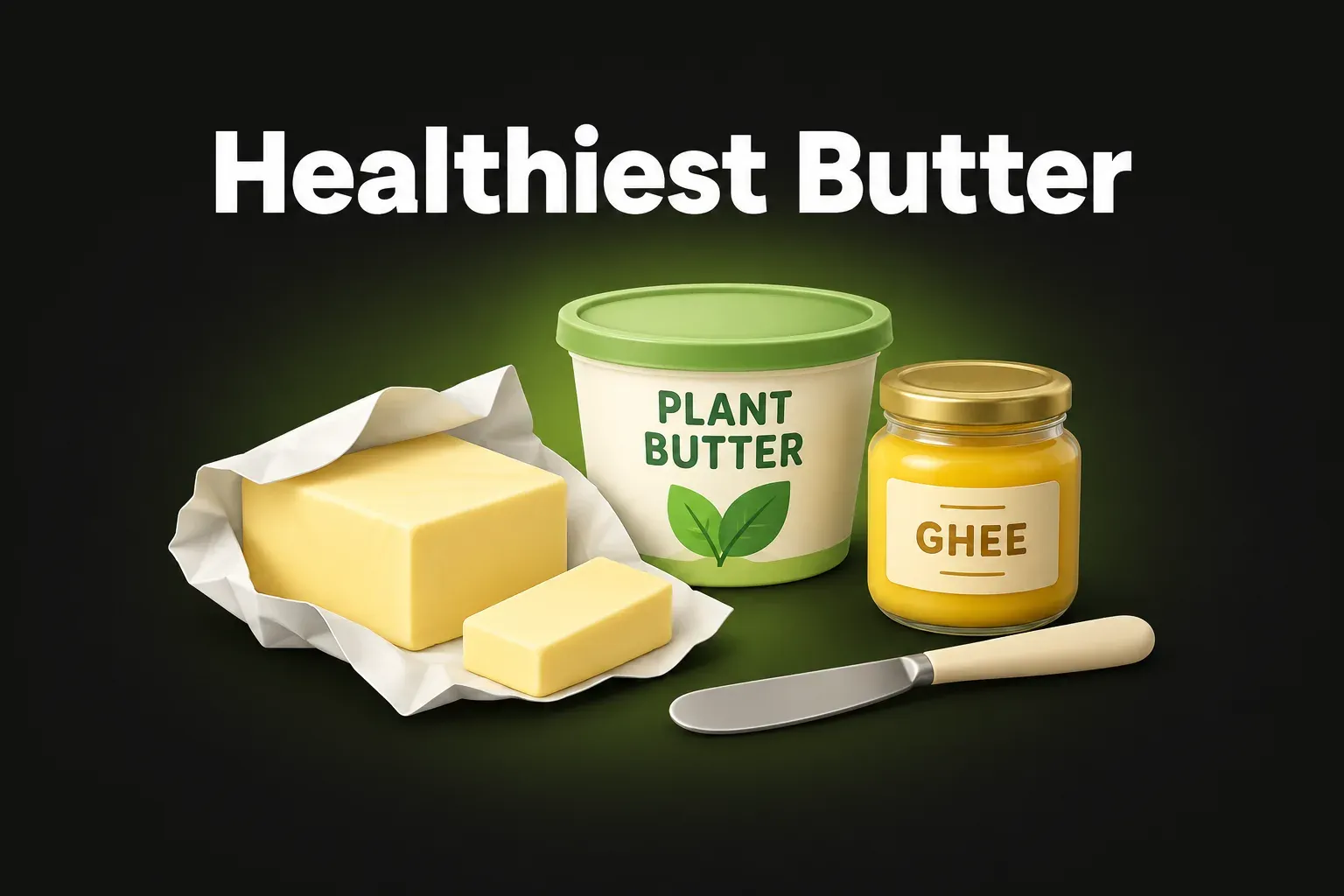
Butter is back in style. Next to it, the shelf now holds grass-fed butter, ghee, light butter, olive oil blends and plant butters. Which one is the healthiest butter?
The short answer: if you use a little, plain butter made from just cream and salt is fine. To cut saturated fat, a butter blended with olive oil is the best middle ground. Plant butters have less saturated fat but often more palm oil and additives. Grass-fed butter and ghee are not much healthier than regular butter. For cooking, olive oil beats them all.
8 butters and spreads compared
| Product | Type | Calories | Sat. fat | Sodium | Fats used | Additives |
|---|---|---|---|---|---|---|
| Land O Lakes Salted Butter | Butter | 100 | 7 g | 90 mg | Milk fat | None |
| Kerrygold Pure Irish Butter (salted) | Grass‑fed butter | 100 | 7 g | 100 mg | Milk fat | None |
| 4th & Heart Ghee Original* | Ghee | 120 | 10 g | 0 mg | Milk fat | None |
| Land O Lakes Butter with Olive Oil & Sea Salt | Blend | 90 | 4.5 g | 95 mg | Milk fat, olive | None |
| Land O Lakes Light Butter with Canola Oil | Light butter | 50 | 2 g | 90 mg | Milk fat, canola | Modified starch, maltodextrin, monoglycerides, potassium sorbate, sodium benzoate, PGPR, xanthan gum, color |
| Country Crock Plant Butter with Olive Oil | Plant butter | 100 | 4 g | 105 mg | Soybean, palm, palm kernel, olive | Soy lecithin, citric acid, natural flavor, calcium disodium EDTA, color |
| Earth Balance Original Buttery Spread | Plant spread | 100 | 3 g | 105 mg | Palm, canola, soybean, flaxseed | Sunflower lecithin, lactic acid, natural flavor, annatto (color) |
| Miyoko’s European Style Salted Plant Milk Butter | Plant butter | 90 | 8 g | 65 mg | Coconut, sunflower, cashew | Sunflower lecithin |
Per 1 tablespoon (14 g). *Ghee: 1 tablespoon = 13 g. Sources: brand pages for Land O Lakes Butter with Olive Oil and Country Crock, Wegmans for Earth Balance, and Open Food Facts labels for the rest. Recipes change – always check the package.
What stands out:
- Regular and grass-fed butter both have 7 g of saturated fat per tablespoon. Grass-fed doesn’t change that.
- Ghee has the most calories and saturated fat, because it’s almost pure fat.
- The olive oil blend cuts saturated fat by about a third and adds no additives.
- Plant butters have less saturated fat, except Miyoko’s, which is made mostly with coconut oil.
- Light butter has half the calories, but it gets there with water and a long list of additives.
Saturated fat: what the research says
Saturated fat is the type of fat that is solid at room temperature. Butter, cheese, coconut oil and palm oil are rich in it. It raises LDL cholesterol. This is the “bad” cholesterol that builds up inside your blood vessels.
The American Heart Association (AHA) suggests getting only 5–6% of your calories from saturated fat (AHA). On a 2,000-calorie diet, that’s about 13 g a day. One tablespoon of butter uses up more than half of it.
Here is what the main studies found:
- Swapping fats in trials. The AHA reviewed the evidence in 2017. In trials, people who replaced saturated fat with vegetable oils had about 30% less heart disease (Sacks et al., Circulation, 2017).
- Cutting saturated fat for 2+ years. A Cochrane review pooled 15 trials with about 59,000 people. Eating less saturated fat cut the risk of heart problems (all types counted together) by 21%. It made little difference to the number of deaths (Hooper et al., Cochrane Database of Systematic Reviews, 2020).
- Butter on its own. A 2016 review looked at butter alone in 636,151 people. Each daily tablespoon was linked to a 1% higher risk of death. It was not linked to heart disease or stroke. It was linked to a slightly lower risk of diabetes (Pimpin et al., PLOS One, 2016). The authors called butter’s effects “small or neutral”.
- Butter vs plant oils. A Harvard study followed 221,054 US adults for up to 33 years. People who ate the most butter had a 15% higher risk of death than those who ate the least. People who ate the most plant oils had a 16% lower risk. The researchers also looked at a swap. Trading about 2 teaspoons (10 g) of butter a day for plant oil was linked to a 17% lower risk of death (Zhang et al., JAMA Internal Medicine, 2025).
- Butter vs olive oil. A UK trial had 94 adults aged 50–75. Each ate 50 g (about 3½ tablespoons) a day of butter, olive oil or coconut oil for 4 weeks. Butter raised LDL cholesterol more than olive oil (Khaw et al., BMJ Open, 2018).
What it means: a little butter is not dangerous. Most of these studies show links, not proof. But they keep pointing the same way. Replacing some butter with liquid plant oils, especially olive oil, is better for your heart.
Grass-fed butter: a little better, not a health food
Grass-fed cows make milk with more omega-3 fats (healthy fats also found in fish and flaxseed). A US study tested 1,163 samples of milk from grass-fed cows over 3 years. It had about 2.5 times the omega-3 of regular milk (Benbrook et al., Food Science & Nutrition, 2018). Some of the authors worked for Organic Valley, a company that sells grass-fed milk. Butter from cows on pasture is also more yellow. The color comes from carotenoids. These are plant pigments like beta carotene, which your body turns into vitamin A (Gómez-Mascaraque et al., Journal of Dairy Science, 2020).
But the amounts are small. Regular butter has only about 0.04 g of omega-3 per tablespoon (USDA). Even 2.5 times more is still tiny. And Kerrygold has the same 100 calories and 7 g of saturated fat as regular butter. Buy grass-fed for taste if you like it – not as a health upgrade.
Ghee: great for high heat, not lighter
Ghee is butter that is cooked until the water boils off. The milk solids are then strained out. What’s left is almost 100% fat. Butter is only about 81% fat – the rest is mostly water.
That’s why ghee has more calories per spoon. USDA lists about 117 calories and 8 g of saturated fat per tablespoon (USDA). The 4th & Heart label says 120 calories and 10 g. Ghee’s real advantages: it doesn’t burn as easily when you fry, and it has almost no lactose (milk sugar). Beef tallow is another animal fat people use for high heat – see is beef tallow healthy?
Light and whipped butter: fewer calories per spoon
| Spread (1 tbsp) | Calories | Sat. fat | How it saves calories |
|---|---|---|---|
| Regular butter (14 g) | 100 | 7 g | – |
| Land O Lakes Whipped Salted Butter (7 g) | 50 | 3.5 g | Air whipped in, still only cream and salt |
| Land O Lakes Light Butter with Canola Oil (14 g) | 50 | 2 g | Water, canola oil and additives |
| I Can’t Believe It’s Not Butter! Original (14 g) | 60 | 2 g | Water first, then soybean and palm oils |
Sources: Open Food Facts labels for Land O Lakes; I Can’t Believe It’s Not Butter! brand page.
Whipped butter is the simplest trick. It’s the same butter with air in it. A spoon weighs half as much, so it has half the calories. Gram for gram, it’s still the same butter.
Light butter replaces part of the butter with water. It needs emulsifiers (ingredients that help oil and water blend) to keep them mixed. It also needs preservatives. Two of these additives have raised questions in independent studies:
- Mono- and diglycerides. The French NutriNet-Santé study followed 92,000 adults for about 7 years. People who ate the most of these emulsifiers (E471) had a 15% higher risk of cancer (Sellem et al., PLOS Medicine, 2024). In the same group, they were also linked to more heart disease and stroke (Sellem et al., BMJ, 2023). In another study, mice ate a diet with 5.5% mono- and diglycerides for 14 weeks. It upset their gut bacteria, blood fat and blood sugar (Panyod et al., Communications Biology, 2024).
- Sodium benzoate. Mice drank water with 0.56–2.25 mg of sodium benzoate per ml for 4 weeks. They had worse memory and balance. Their brains also showed more signs of cell damage (Khoshnoud et al., Journal of Biochemical and Molecular Toxicology, 2018).
Why do mouse studies matter? Mice share most of our genes and body processes. Testing these doses on people would put their health at risk. The doses were much higher than a spoon of light butter, and human proof is missing. Still, studies from different labs point the same way. Limiting these additives is a sensible precaution. Read more about mono- and diglycerides, sodium benzoate and potassium sorbate.
Plant butters and margarine: palm oil and seed oils
Old stick margarine was made with partially hydrogenated oils, a source of trans fat. Trans fat is the worst fat for your heart. The FDA banned these oils, and they had to leave foods by 2018–2021 (FDA). Today’s spreads don’t have them.
Most plant butters now use two kinds of oil:
- Palm and palm kernel oil. They make the spread firm like butter. But they are rich in saturated fat. A review of trials compared palm oil with liquid plant oils. Palm oil raised LDL cholesterol by about 9 mg/dL more (Sun et al., Journal of Nutrition, 2015). More in our guide to palm oil.
- Seed oils like soybean, canola and sunflower. They are rich in linoleic acid, an omega-6 fat. A large study pooled data on 68,659 people from 13 countries. People with more linoleic acid in their blood or body fat had less heart disease (Marklund et al., Circulation, 2019). Two authors had research funding from Unilever, a food company, for this work. See our full article on seed oils.
On labels, look at where olive oil appears. In Country Crock Plant Butter with Olive Oil, it comes after soybean, palm and palm kernel oil. So most of the fat is not olive oil. Miyoko’s is mostly coconut oil – 8 g of saturated fat per spoon, more than butter. Read why in our coconut oil guide.
Plant butters are a good fit if you avoid dairy. They usually have less saturated fat than butter. But they are more processed. Country Crock also has calcium disodium EDTA, a preservative (read about EDTA).
How to pick the healthiest butter: 5 checks
| Check | Aim for | Why |
|---|---|---|
| Ingredients | Short list | Cream and salt, or a few oils – fewer additives |
| Saturated fat | Under 5 g per tbsp | Butter has 7 g, over half the daily limit |
| Main oil | Olive or canola first | Palm and coconut oil are high in saturated fat |
| Sodium | Under 100 mg per tbsp | Or pick unsalted |
| Trans fat | 0 g, no “partially hydrogenated” | The worst fat for your heart |
A few more tips:
- Measure it. A tablespoon has about 100 calories. See how many calories are in butter.
- Cook with olive oil and add a little butter at the end for taste. See the calories in olive oil.
- Use whipped butter on toast – it spreads thin and has half the calories.
Compare butters and spreads in the store. With NutriSmart, you photograph the label or scan the barcode. The app lists the preservatives, colors and other additives, explains the risks of each one and gives the product a health score out of 100. It also tells you right away if a spread is ultra-processed and which ingredients make it so. You can even set an alert for an additive like sodium benzoate. The app then warns you whenever a scanned product contains it.Get the app free
You can also read about the healthiest milk and the healthiest cheese.
The bottom line
There is no perfect butter, but some are better than others. Plain butter with only cream and salt is fine in small amounts. A butter blended with olive oil cuts saturated fat with no additives. Plant butters have less saturated fat but often more palm oil and additives. Grass-fed butter and ghee are not real health upgrades. Use any of them sparingly, and cook with olive oil when you can.
FAQ
What is the healthiest butter?
Plain butter with only cream and salt is the cleanest choice if you use a little. If you want less saturated fat, a butter blended with olive oil is a good middle ground. For cooking, olive oil beats every butter and spread.
Is grass-fed butter healthier than regular butter?
Only a little. Grass-fed butter has more omega-3 fats and beta carotene, but the amounts per spoon are small. It has the same calories and about the same saturated fat as regular butter.
Is ghee healthier than butter?
Not really. Ghee is almost pure fat, so a tablespoon has more calories (about 120) and as much or more saturated fat than butter. It's good for high-heat cooking and has almost no lactose.
Is plant butter healthier than real butter?
Most plant butters have less saturated fat than butter – about 3–4 g per tablespoon instead of 7 g. But many are made with palm oil and have more additives. Coconut-based plant butters can have as much saturated fat as butter.
Is margarine healthier than butter now?
Today's spreads no longer use partially hydrogenated oils, the main source of trans fat. The FDA banned them. Most spreads have less saturated fat than butter, but they are more processed, so check the ingredient list.
How much butter is OK per day?
The American Heart Association suggests keeping saturated fat to about 13 g a day on a 2,000-calorie diet. One tablespoon of butter has about 7 g. So 1–2 teaspoons a day leaves room for other foods.